
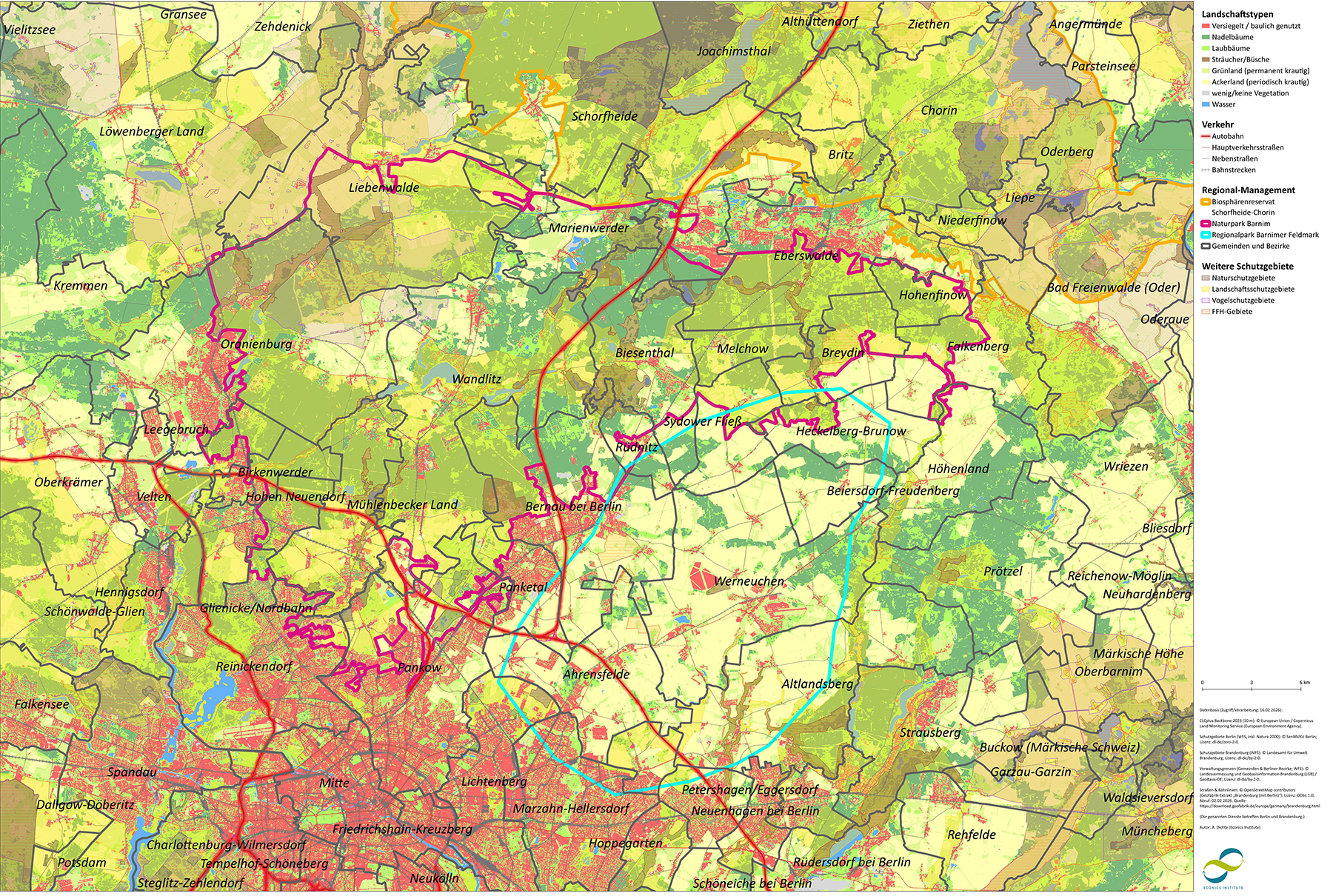
What conditions would an “Urban Biosphere Region Berlin–Barnim” require — and which organizational or financial models could make it work? The feasibility study aims to develop a robust professional basis, including scenarios, maps, and recommendations for possible next steps. The Berlin–Brandenburg metropolitan region is characterized by dynamic land use and development processes, while at the same time boasting a high diversity of landscapes and essential ecological functions. The study examines whether, and under what conditions, an “Urban Biosphere Region Berlin–Barnim” would be meaningful, achievable, and beneficial — particularly with regard to urban–rural relations, nature conservation, climate adaptation, and sustainable regional development.
The study looks at a potential area broadly covering Barnim Nature Park, the Regional Park Barnimer Feldmark, and the northern Berlin districts of Reinickendorf, Pankow, Lichtenberg, and Marzahn-Hellersdorf. A fixed boundary has not yet been determined; one of the study’s tasks is to develop and compare different spatial scenarios and boundary options.
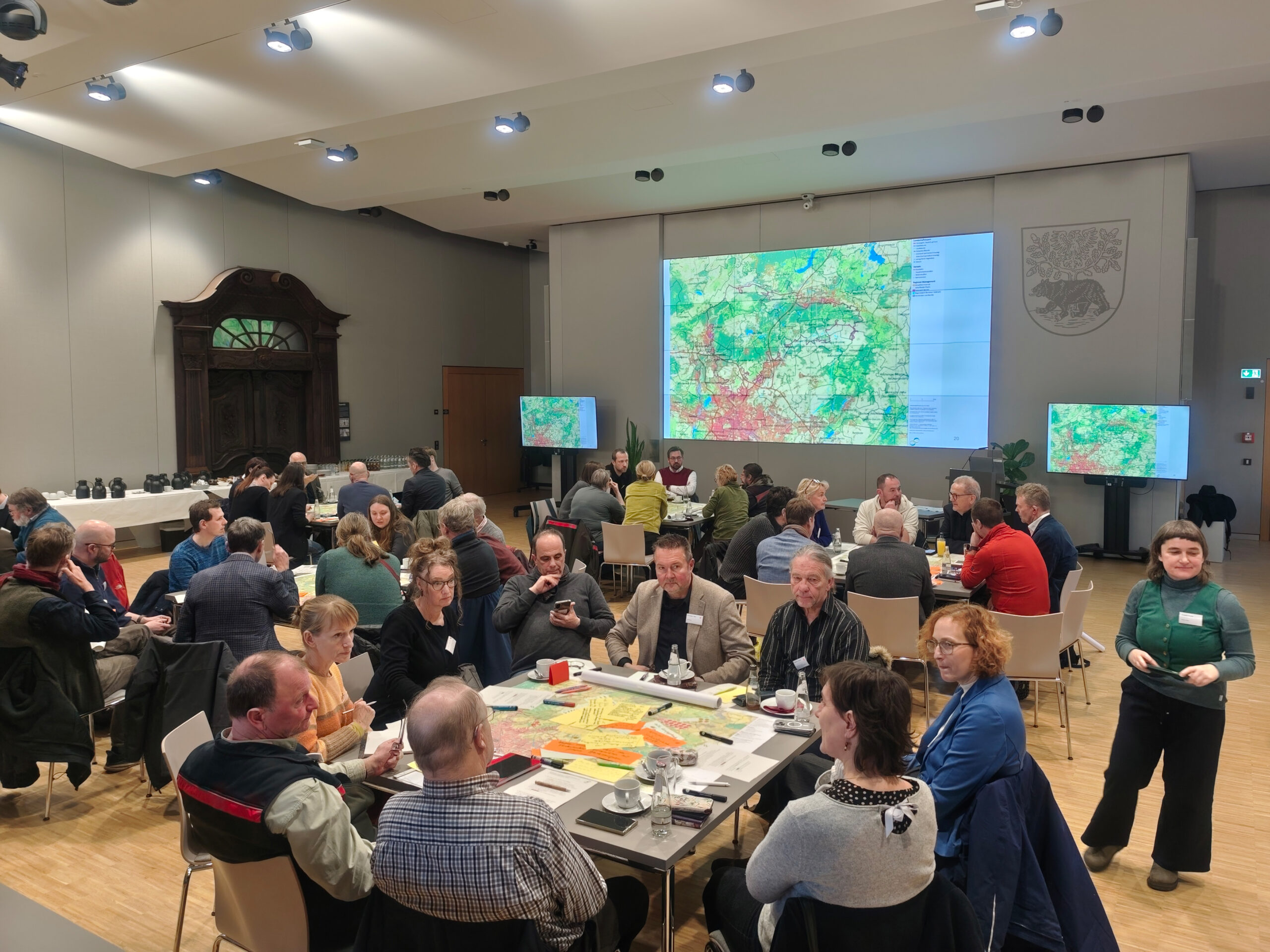
Methodologically, the study combines GIS and data analyses with a qualitative research component, including 15 guided interviews with key stakeholders. The process is closely supervised by a steering group, complemented by a project-based working group serving as a platform for exchange. This approach brings together technical evidence, implementation logic, and governance considerations in a coherent way.
The outcomes will include a brochure and a final report featuring maps, scenarios, and recommendations — including organizational and funding options for the potential next phase in developing the “Urban Biosphere Region Berlin–Barnim.”
Feasibility, Organisational, and Financing Study
Commissioning entity: Kommunales Nachbarschaftsforum Berlin–Brandenburg e.V. (KNF e.V.).
Project partners: Econics Institute e.V. (Lead) | E.C.O. Institut (Unterauftrag) | Prof. Dr.-Ing. Jörg Knieling (HafenCity Universität Hamburg, Mitglied des deutschen MAB-Nationalkomitees).
Project period: December 1, 2025 – May 31, 2027
Contact: Angela Dichte (angela.dichte@econics.institute)