
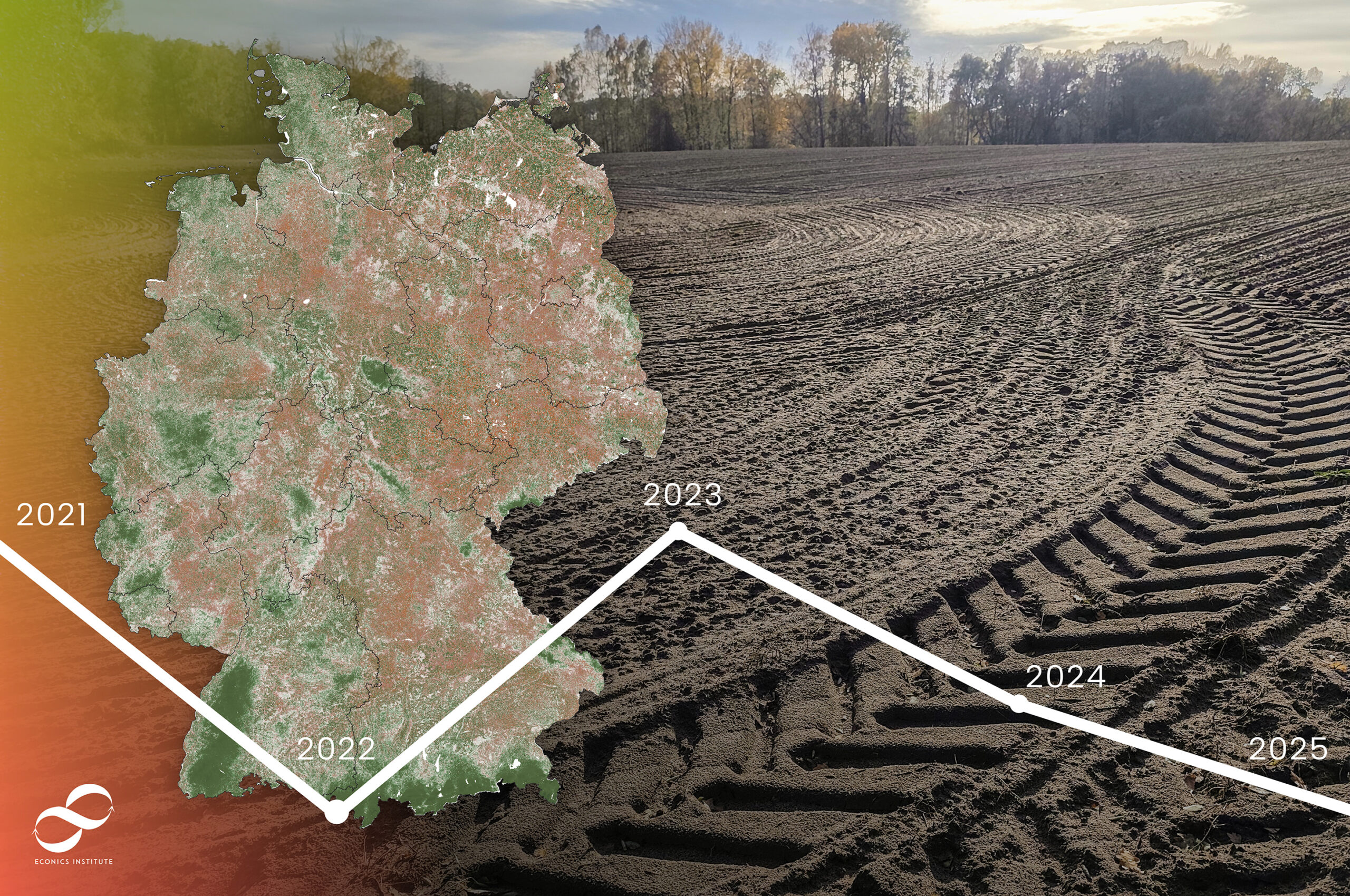
The ECONICS Green-Moist-Cool Index is a composite index for ecosystems, similar to economic indices that serve as established indicators summarizing complex economic dynamics into a single, easily understandable metric, making trends and systemic risks recognizable at an early stage. First introduced in 2025 by the ECONICS INSTITUTE, the “Green-Moist-Cool Index” transfers this principle to natural ecosystems using real measured data and developed a functional framework for evaluating the condition and regulating capacity of the “working landscapes” that represent the natural infrastructure.
Cities with limited vegetation are known to heat up rapidly during hot periods, increasing health risks for residents under climate change. This phenomenon, widely studied as the urban heat island effect, has received considerable research and policy attention. However, far less attention has been paid to the existence of wider heat landscapes, non-urban areas that experience elevated land surface temperatures due to vegetation loss, land degradation, and intensive land use. It is evident that these landscapes are characterized by not only a temperature anomaly but also a general reduction in functionality. While they may provide agricultural products or human infrastructure, vulnerable landscapes, especially under climate change, can also pose a risk to human well-being.
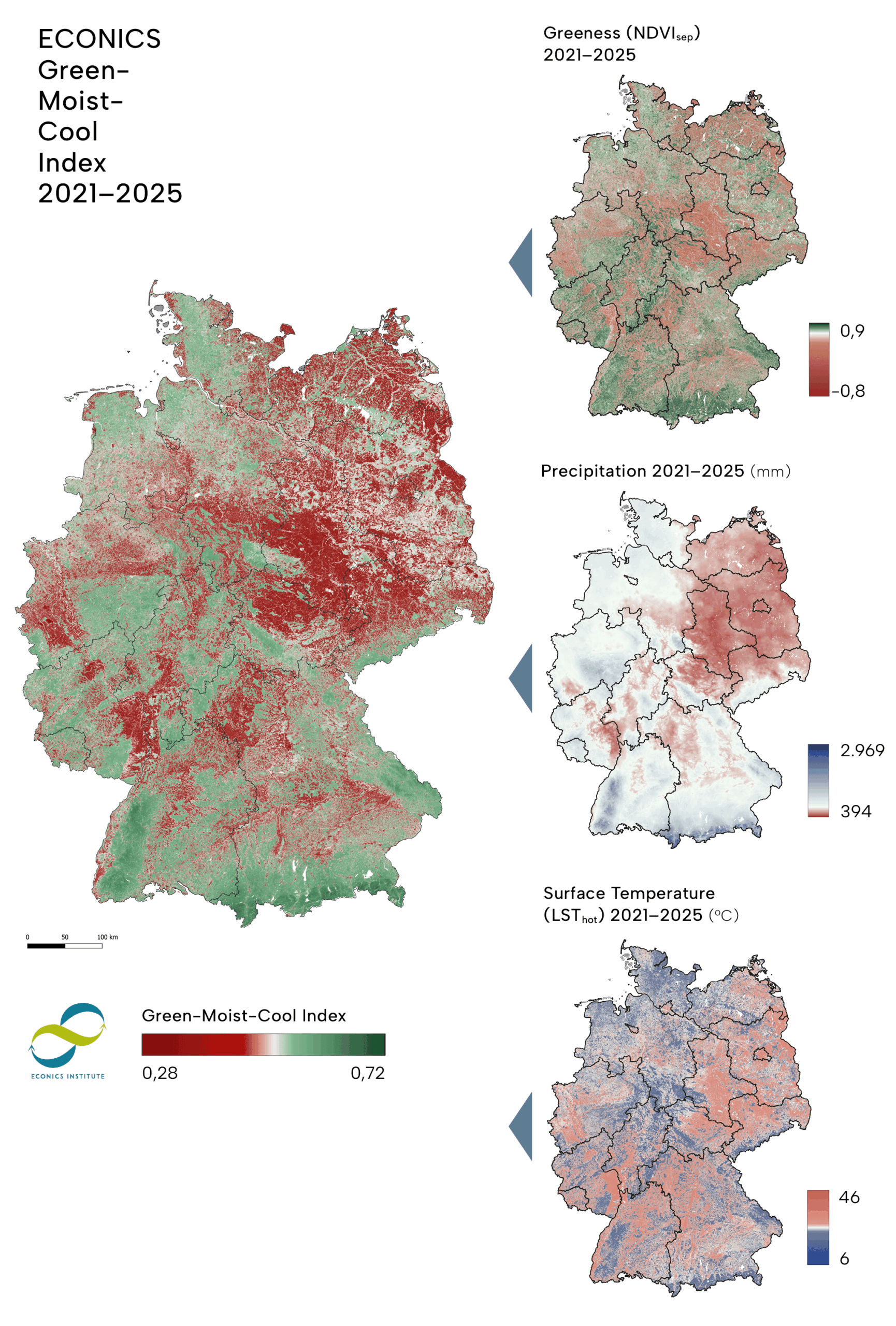
The Index‘s methodology is based on the analysis and integration of satellite-based and meteorological data in a 30 x 30 meter grid, thereby creating a novel instrument that enables a systematic assessment of the landscape working capacity. Threee dimensions provide an integrated measure of whether ecosystems remain functionally active and capable of delivering ecological benefits under increasing climatic stress.
- Green: late summer vegetation greenness (average NDVI values measured in September)
- Moist: annual precipitation, provided by the German Weather Service (Deutscher Wetterdienst (DWD)
- Cool: Land Surface Temperature (LST) on the hot days, defined as days on which at least one pixel in Germany reached or exceeded 40°C at 30 m resolution
Following peer review, the study on the Green-Moist-Cool Index has been published: Adhikari, Y., Ibisch, P. L., Wohlleben, P., Schneider, A., & Johnson, D. (2026). Working landscapes under climate change need to be green, moist, and cool — A case study of Germany. Ecological Solutions and Evidence, 7(2), e70270. Its results provide evidence that thermal regulation, vegetation cover, and moisture availability are tightly coupled at the national scale, supporting “green-moist-cool” as a fundamental ecological triad sustaining working landscapes. In particular, the study demonstrated the central importance of healthy vegetation for regional cooling and hydrological stability in Germany.
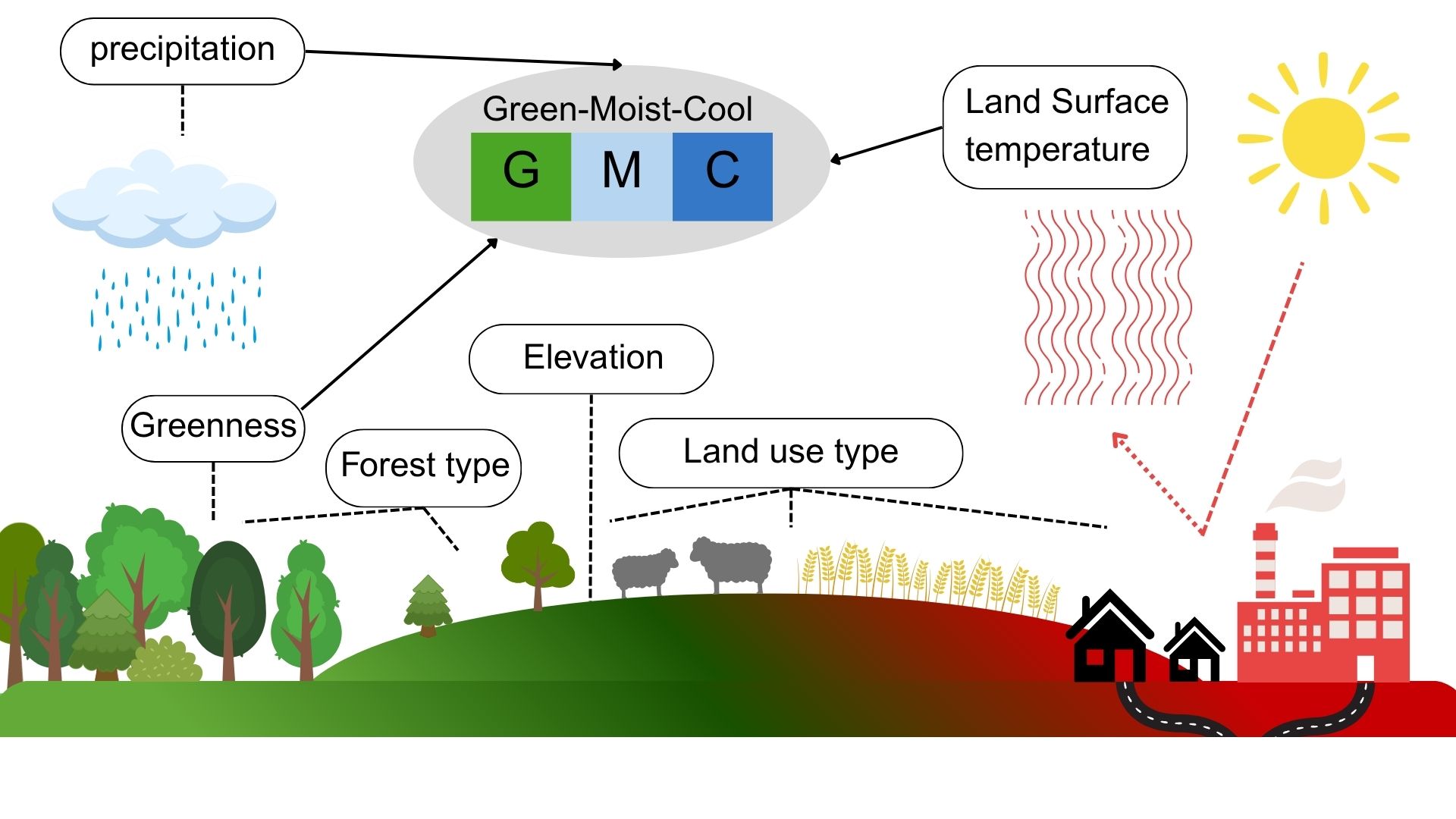
Green and vital vegetation is associated with higher precipitation levels and relatively lower temperatures. It is a remarkable finding that end-of-summer vegetation greenness proved to be the parameter that predicts lower surface temperatures more reliably than precipitation or elevation above sea level. This result underscores that rain alone does not guarantee ecological moisture availability; rather, it is vegetation that determines whether precipitation is effectively retained and recycled, leading to cooler and more resilient landscapes. Moreover, vegetation even contributes to local precipitation through evapotranspiration, releasing water vapor back into the atmosphere as part of the hydrological cycle. The green-moist-cool triad thus reinforces itself through positive feedback loops: where it is cooler and moister, green vegetation can thrive, which in turn retains water more effectively and can cool its surroundings even at higher temperatures.
However, such feedback loops also come into play where it becomes critically hot and dry: living conditions for plants deteriorate, and they can no longer cool and moisten their surroundings. Heat, drought, and the weakening of green vegetation fuel one another, which can lead to a downward spiral in which the working capacity of ecosystems declines — with negative consequences for all ecosystem services that people have an interest in. This includes, not least, nature’s natural climate protection function: in drying and weakened forests and peatlands, carbon is released, which in turn further drives climate change.Key findings: Land use influences the distribution of surface temperatures in Germany by almost one-fifth — more than any other factor. And where it is greener and cooler, there is even more precipitation — and not only in mountain regions. Per unit of the vegetation index used, the 2018–2024 study period showed an average increase of 297 millimeters in annual precipitation. Green vegetation, water, and relative coolness form a mutually reinforcing triangular relationship.
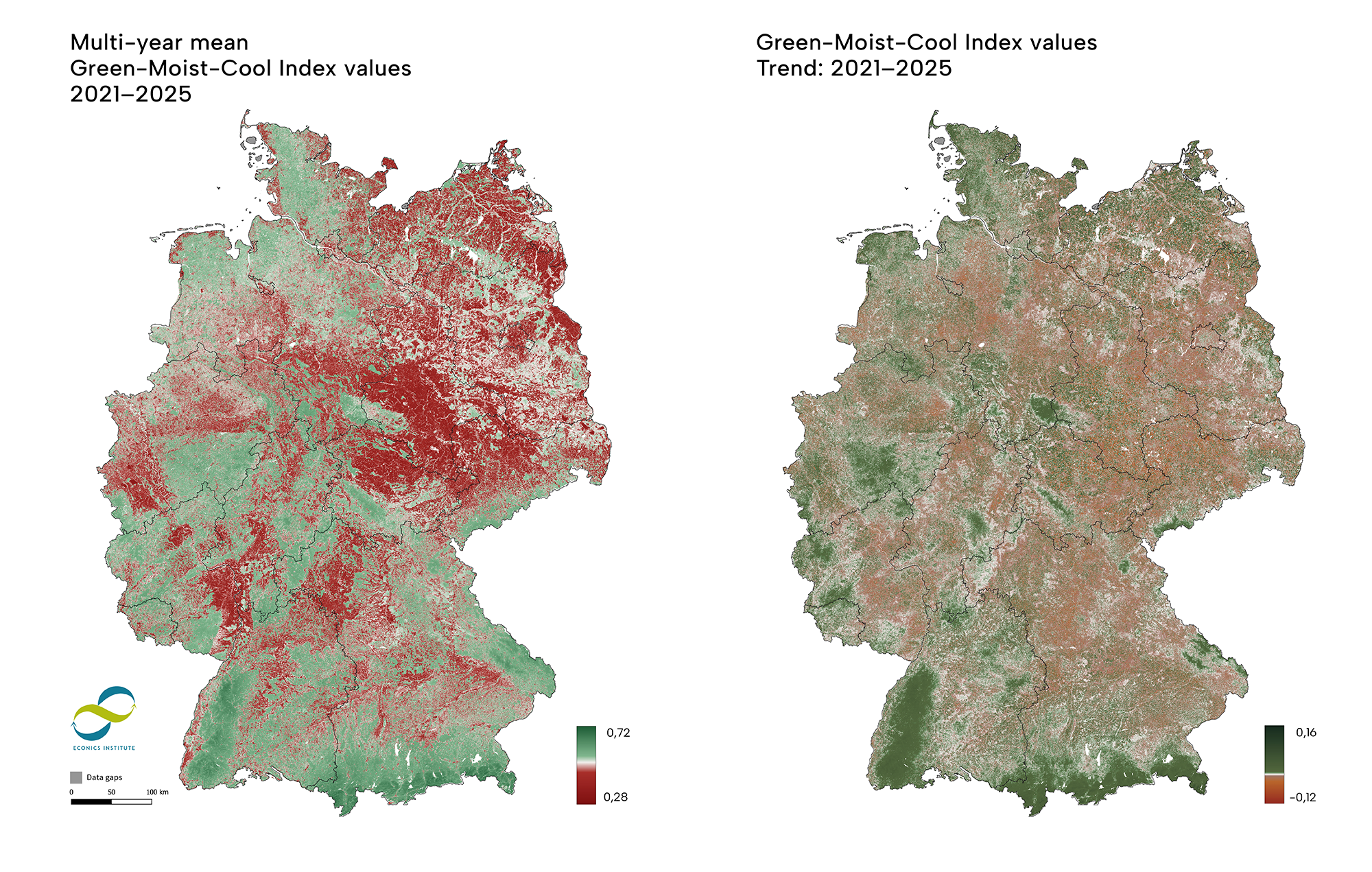
The index published in 2026 is based on the average values for the years 2021 to 2025 and confirms the spatial patterns of the first reporting period (2018–2024): the greener, moister, and better connected a landscape is, the greater its capacity to buffer heat stress.
For the first time, not only the absolute mean green-moist-cool values have been mapped at high spatial resolution, but also the five-year trends have been calculated. The index shows: many landscapes are losing their ability to retain water and regulate temperatures. Following a general improvement in index values in 2023, a decline has been recorded over the past two years. In 2025, the nationwide index average is 16% lower than in 2021. The decline from 2024 to 2025 amounted to 7.2%.
This year’s reporting also includes the ecological connectivity of green-moist-cool areas (Ecological Coreness). Together with the green-moist-cool values (mean index value) and their trends, this new metric is used for a nationwide zoning of the Natural Infrastructure. The high-resolution maps can be interpreted and used at the regional or local level. The methodological extensions have been submitted for publication and are publicly available as a preprint: Adhikari, Y., Engelhardt, I. M. & Ibisch, P. L. (2026). Quantifying priorities for restoration and conservation of natural infrastructure.
The new data confirms the fact that urban areas and industrial zones in particular heat up disproportionately on hot days. In addition, intensive, structurally impoverished agriculture, the overuse and mismanagement of forests, as well as the continuous expansion of infrastructure of all kinds, are weakening nature’s working capacity. Increasing fragmentation destroys ecological corridors, resulting in a loss of cooling and buffering functions; production risks in agriculture and forestry are also rising.
Nature is not merely a green backdrop we visit and admire for recreation and relaxation, nor is it a warehouse from which we simply take what we need for our economic activities. Rather, nature consists of complex systems that, quite literally, perform work in order to exist and function. Through this physical work — in a thermodynamic sense—nature also creates the very foundation of our existence.
The good news: the new findings show just how great the opportunity is to strengthen resilience against the climate crisis through changed land use — with the Natural Infrastructure of Germany’s entire national territory being of overriding public interest. To address the climate change-driven rise in temperatures and the associated burdens on people and the environment, functional landscape units must be understood systemically and protected and preserved through proactive, preventive management. The differentiated promotion and treatment of the relevant areas are necessary, ecologically and economically sensible, and feasible.
The summary report for the 2021–2025 reporting period (in German) can be downloaded here. The previous year’s report, covering 2018–2024 (also in German), is available here. The scientific paper on the Green-Moist-Cool Index is open access and freely available from Ecological Solutions and Evidence: