
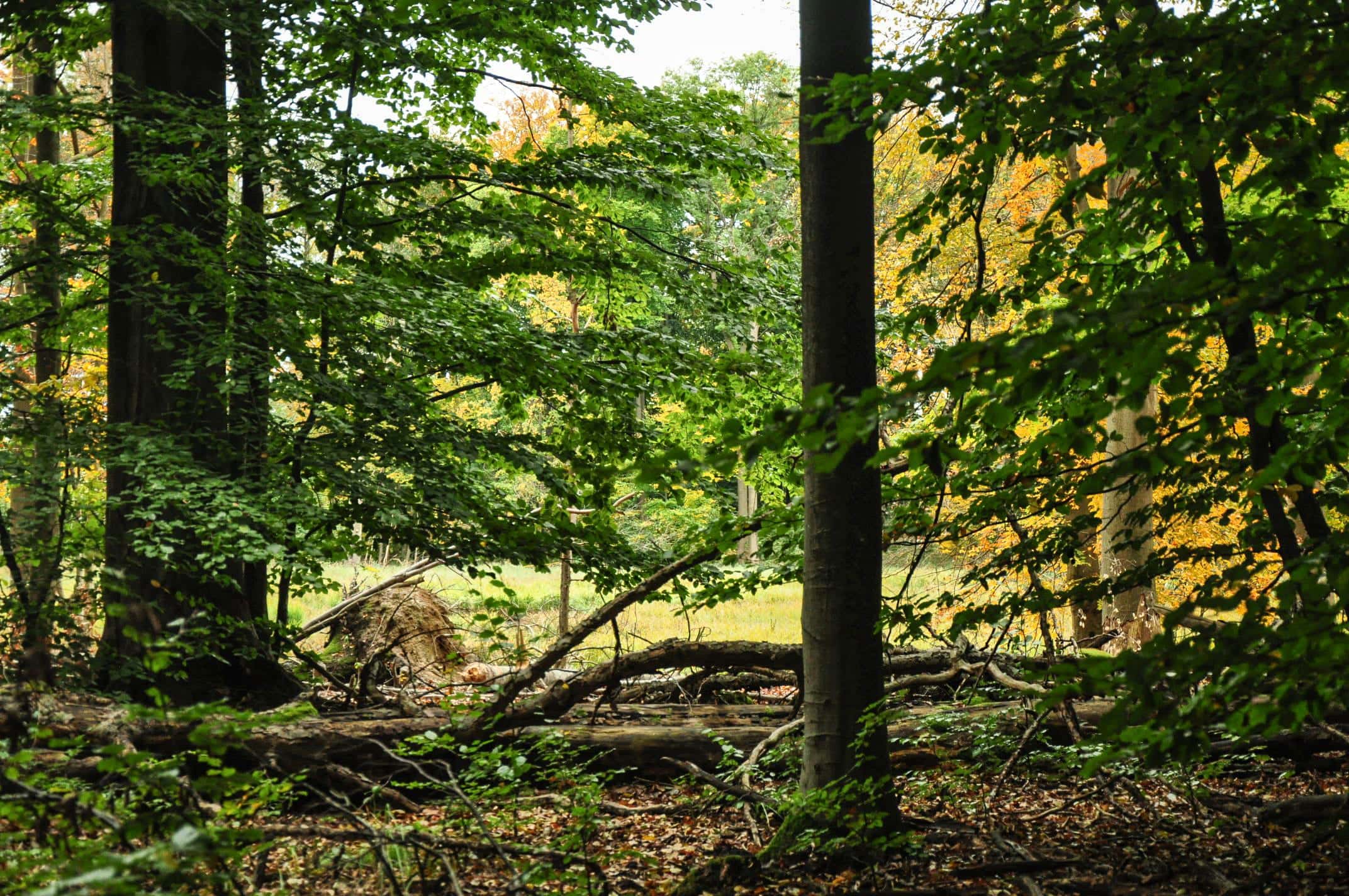
Germany’s forests are under pressure. Drought, heat, bark beetles and fires are causing severe damage. For years, there has been intense debate about how to make forests more resilient to climate change: Do forestry interventions and logging help – or do forests above all need protection and time to recover? A new study by the ECONICS INSTITUTE, commissioned by the NABU-Foundation for National Natural Heritage, has reviewed several hundred international research papers on this question. The key message: many widely held assumptions about the benefits of intensive forest management do not stand up to scientific scrutiny. Near-natural forests and forests left to develop naturally often prove to be the better answer to the climate crisis.
The new report “Climate Protection in Temperate Forests – A Comparative Analysis of the Evidence on the Effectiveness of Process Protection vs. Active Management Strategies” by Dr Axel Schick and Prof. Pierre Ibisch, presented on 17 November 2026, tests four assumptions that are often used to justify active forest management:
- Managed forests store more carbon than forests without logging.
- They are better equipped to cope with the effects of climate change.
- ‘Climate-smart’ forestry makes forests more resilient.
- Using wood does more for the climate than protecting the forest.
In total, 313 scientific journal articles and book chapters were reviewed. The result: none of these four assumptions is supported by the scientific evidence in its general form.
The research of recent years paints a clear picture: wilder, less intensively used forests are not a passive alternative to management but an active part of the solution. They store carbon, cool their surroundings, retain water and are often better able to adapt to change than was long assumed. As the climate crisis rapidly intensifies, we should rely more on the natural capacities of forest ecosystems.
Prof. Pierre Ibisch
Susanne Winter, head of the Schorfheide-Chorin Biosphere Reserve, also attended the presentation. She sees the findings confirmed by experience in the reserve’s unmanaged core zone: in the Grumsin beech forest, part of the UNESCO World Heritage site Ancient and Primeval Beech Forests of the Carpathians and Other Regions of Europe, the growing stock – and with it the stored carbon – increased by almost 183 cubic metres per hectare between 2000 and 2022, even though climatic stress on the trees is rising there too.
Every summer, the forest crisis shows us once again how urgently we need to act. The study makes it clear: the best ally in the fight against the climate crisis is the forest itself. Restoring degraded forests and giving near-natural forests room to develop strengthens climate protection, species conservation and water protection all at once. The EU Nature Restoration Regulation provides an important framework for this, and Germany must now implement it with determination.
NABU President Jörg-Andreas Krüger
The study is particularly critical of the widespread hope that using more wood helps protect the climate. Wood can, in some circumstances, replace fossil resources or energy-intensive materials. However, these substitution effects are often greatly overestimated: energy use and short-lived products such as paper, packaging or wood-based panels frequently have only small or even negative net climate effects, because the carbon debt caused by harvesting exceeds the short-term gains – and is often only repaid after several decades or even centuries. At the same time, logging further weakens forests already stressed by climate change and damages important carbon stores.
Speaking to the German broadcaster MDR, Krüger stressed: “Especially for old forest sites, the less you touch them, the better for the climate.” At the same time, he said, managed forests are also needed to supply the timber we use. Because pure conifer forests suffer particularly badly from climate change, more hardwood will become available in future. Krüger therefore argues that beech, for example, should increasingly be used for long-lived products rather than burned – burning wood, he says, is like taking out a ‘carbon loan’.
The authors stress that there is no one-size-fits-all solution for every forest. In most contexts, however, protecting and expanding unmanaged forest ecosystems is the more effective strategy for the climate. Natural forests without timber harvesting should therefore be seen as an investment in long-term, robust nature-based climate protection, in climate change adaptation and in buffering climate extremes. As part of our natural infrastructure, wild forests are of overriding public interest.
The detailed findings on all four assumptions and the full list of literature reviewed can be found in the report (in German).