
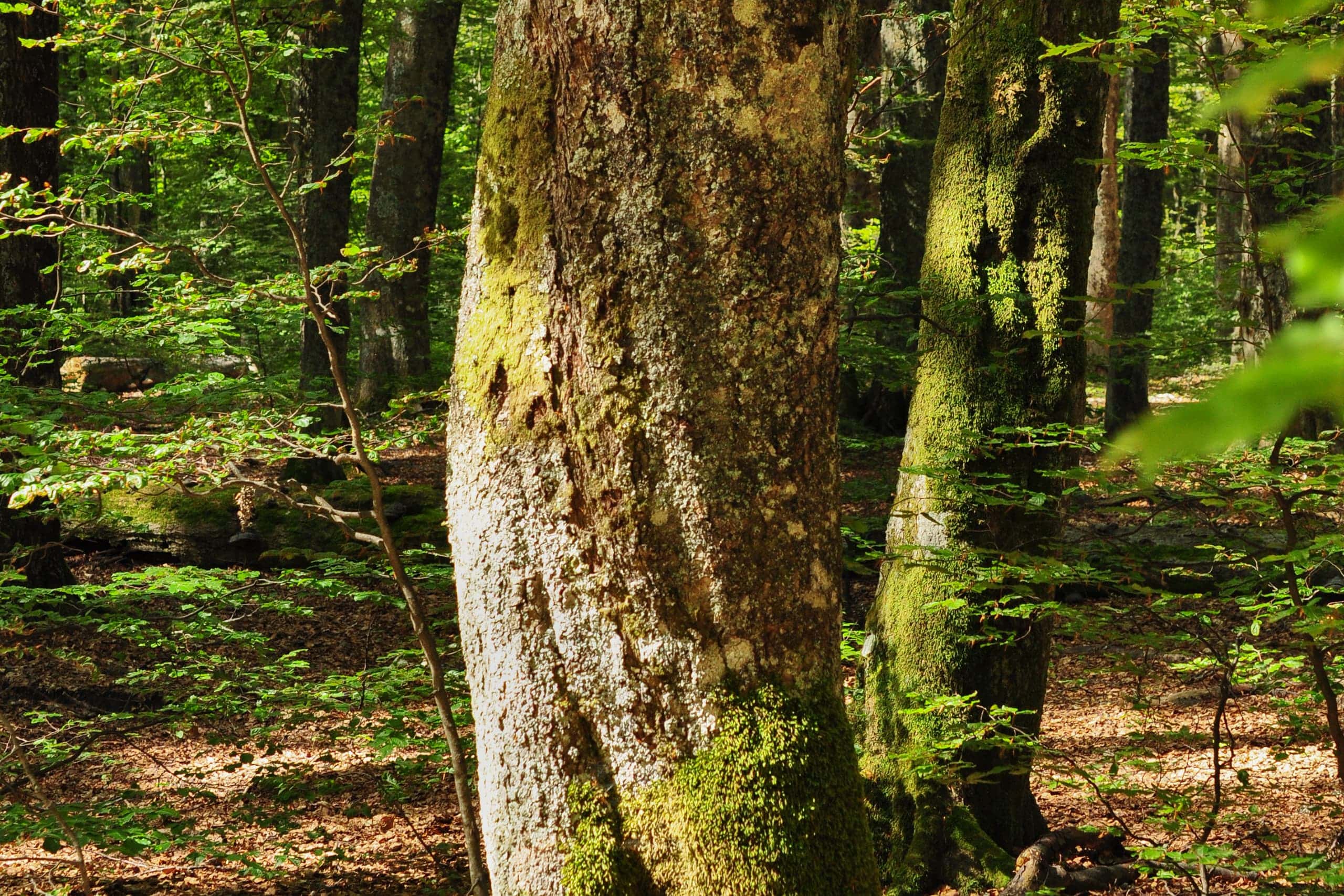
Commissioned by the NABU-Foundation for National Natural Heritage, the ECONICS INSTITUTE has tested four central assumptions of the forestry debate against several hundred scientific studies. The result: in most contexts, protecting and expanding unmanaged forest ecosystems is the more effective strategy for the climate.
Central assumptions of forestry stakeholders put to the test
As a result of human-caused climate change, the forests of Central Europe are in an existential crisis. In response, those working in forestry and in nature conservation are proposing a wide range of measures. While both sectors largely agree on the overarching goal of climate-resilient, structurally rich mixed forests, they differ considerably in the means they choose, on how to weigh the evidence and on how they see the role of humans in forest ecosystems.
It is important to stress that there is no single position held by ‘forestry’ or by ‘nature conservation’. The spectrum of ideas ranges from those who favour ecosystem-based approaches to those who are convinced that active management is indispensable. Motivations vary just as widely, from producing timber as a raw material to prioritising the full range of ecosystem services, the regulating ones in particular.
Nevertheless, four central assumptions stand out in the debate over consequences and management options: Forestry stakeholders regularly draw on them to make the case that active management is necessary. They hold that:
- Managed forests contribute more to mitigating climate change than unlogged forests because they sequester more carbon
- Managed forests are more resilient to climate change than unlogged forests
- ‘Climate-smart’ forestry increases the resistance and resilience of forests compared with management without such measures
- Substituting wood for non-wood materials and fuels contributes more to climate protection than refraining from timber harvesting
313 studies systematically reviewed
The scientific report by Dr Axel Schick and Prof. Pierre Ibisch, “Climate Protection in Temperate Forests – A Comparative Analysis of the Evidence on the Effectiveness of Process Protection vs. Active Management Strategies” (available in German), has tested them systematically against the empirical literature. In total, 313 scientific journal articles and book chapters were taken into account. Each study was classified according to whether its findings support the assumption in question, contradict it or provide mixed evidence. The full dataset of this classification is available in German (see below).
The result: none of the four assumptions is supported by the scientific evidence in its general form.
Do managed forests store more carbon than unmanaged forests?
European field studies consistently show that unlogged primary forests hold substantially larger stocks in every carbon pool measured (above-ground biomass, deadwood and soil) than comparable managed stands. For beech forests, the deficit in above-ground biomass alone is around 50%. The importance of carbon stores in deeper soil layers, the role of the soil microbiome, and the release of soil carbon caused by forestry tend to be greatly underestimated. Thinning, for instance, mobilises centuries-old carbon in the subsoil through the microbial priming effect, among other things. Commercial forests taken out of timber production slowly refill their depleted stores and, as they age, gradually approach the stocks of primary forests. The widespread assumption that older and protected forests are carbon-neutral – in other words, that their sink function ceases – has been empirically refuted. Stands up to 800 years old typically show positive net ecosystem productivity, and stands more than 200 years old sequester 2.4 ± 0.8 Mg C ha⁻¹ yr⁻¹ on average.
Are managed forests better equipped to cope with the effects of climate change?
Ecological resilience, too, is often misjudged in the forestry debate. Unmanaged forests in Germany have a 22% lower disturbance rate and 32% lower disturbance severity than comparable managed forests, and this advantage grows further in climatically extreme years. Broken down by disturbance type, the evidence likewise largely contradicts the assumption that management makes forests more resilient. For fire, all five studies included contradict it, which suggests that forestry interventions consistently fail to improve post-fire resilience and often worsen it by removing tree biomass; for bark beetles and drought, around 60% contradict it, while the picture for windthrow is more differentiated. Active intervention has only been shown to help in one specific case: converting artificial spruce monocultures into mixed forest. For near-natural broadleaf forests, there is no comparable evidence that intervention makes them more resilient in the long run than allowing them to develop naturally.
Importantly, the greater resilience of unlogged forests does not stem from a static state of heightened resistance. Rather, it is the result of a dynamic, self-regulating system made up of three functionally linked elements: structural complexity, biological and ecological endowment, and microclimatic buffering capacity. These elements work in synergy and can be weakened, deliberately or inadvertently, by individual forestry interventions.
Yet specific ‘climate-smart’ forestry measures have, under certain circumstances, increased the resilience of individual stands. Of the 71 studies reviewed on this question, 82% support the assumption. However, 96% also report trade-offs, context-specific limitations or negative effects at other levels of the system. This is best illustrated by thinning, the most common and most thoroughly studied measure of climate-smart forest management. Intensive thinning reduces competitive stress, increases the hydraulic efficiency of the remaining trees and lowers their susceptibility to drought. At the same time, it opens up the canopy, increases the vapour pressure deficit, reduces the microclimatic buffering effect and, beyond species-specific stability thresholds, can increase the risk of windthrow – three mechanisms that can intensify the very extreme events that ‘climate-smart’ measures are meant to protect against. These negative effects are not random exceptions but the inevitable consequence of intervening in the adaptive cycles of structurally complex systems.
Is using wood more effective for climate protection than protecting the forest?
The study is particularly critical of the widespread hope that using more wood helps protect the climate. Wood can, in some circumstances, replace fossil resources or energy-intensive materials. While at the level of individual products, a substitution benefit can be measured, research shows that at market, sector and system level these effects are often greatly overestimated. At the same time, logging further weakens forests already stressed by climate change and damages important carbon stores.
Conclusion: near-natural forests are allies in the climate crisis
There is no evidence base for the conclusion that management is necessary to prevent the loss of forests and their natural climate protection functions. In certain contexts, however, the active conversion of vulnerable, extensive conifer monocultures through ecologically sound adjustments to species composition is justified and useful. In reorganisation phases after disturbances, this can accelerate the transition to more climate-resilient species compositions – faster than would be expected from natural succession alone within the time frame considered. At the same time, this argument should primarily be understood as a justification for the ecological restoration of already degraded commercial forests – not as a general justification for forestry management as an overarching system, nor as an argument against protecting or expanding self-organising natural forests.
Rather: Allowing forests to grow wilder – leaving them permanently to natural processes, so that their ecological buffering functions can develop by themselves – is an effective and efficient form of nature-based climate protection and adaptation. These functions include water retention, water recycling and cooling. They are well documented, yet their importance is still systematically underestimated.
The authors stress that there is no one-size-fits-all solution for every forest. In most contexts, however, protecting and expanding unmanaged forest ecosystems is the more effective strategy for the climate. Wild forests are part of our natural infrastructure and urgently need to be fostered and preserved. They are of overriding public interest and deserve to be prioritised accordingly by society and policymakers.
The detailed findings on all four assumptions and the full list of literature reviewed can be found in the report (in German). The full dataset of the literature review, listing all studies reviewed and how they were classified for each assumption, is also available as an Excel file (in German).