“Managing forests? Yes, but social ecologically, please!”
As part of an event organized by the State Working Group on Trees at BUND Saxony-Anhalt, Prof. Dr. Pierre Ibisch presented a new approach to socio-ecological wetland management.
Founded in 2025, ECONICS INSTITUTE e.V. is a think tank for ecosystems. It emerged from the Centre for Econics and Ecosystem Management at the Eberswalde University for Sustainable Development and brings together applied scientific and practical expertise on dealing with ecosystems in the climate crisis.
The ECONICS INSTITUTE e.V. stands for the “econic” approach, i.e., learning from nature’s economy for sustainable human economic activity. Our conceptual foundation is a holistic view of the landscape as a complex socio-ecological system. We want to contribute to the functioning of specific ecosystems.
The headquarters of the non-profit association is located in Chorin in the UNESCO Schorfheide-Chorin Biosphere Reserve.
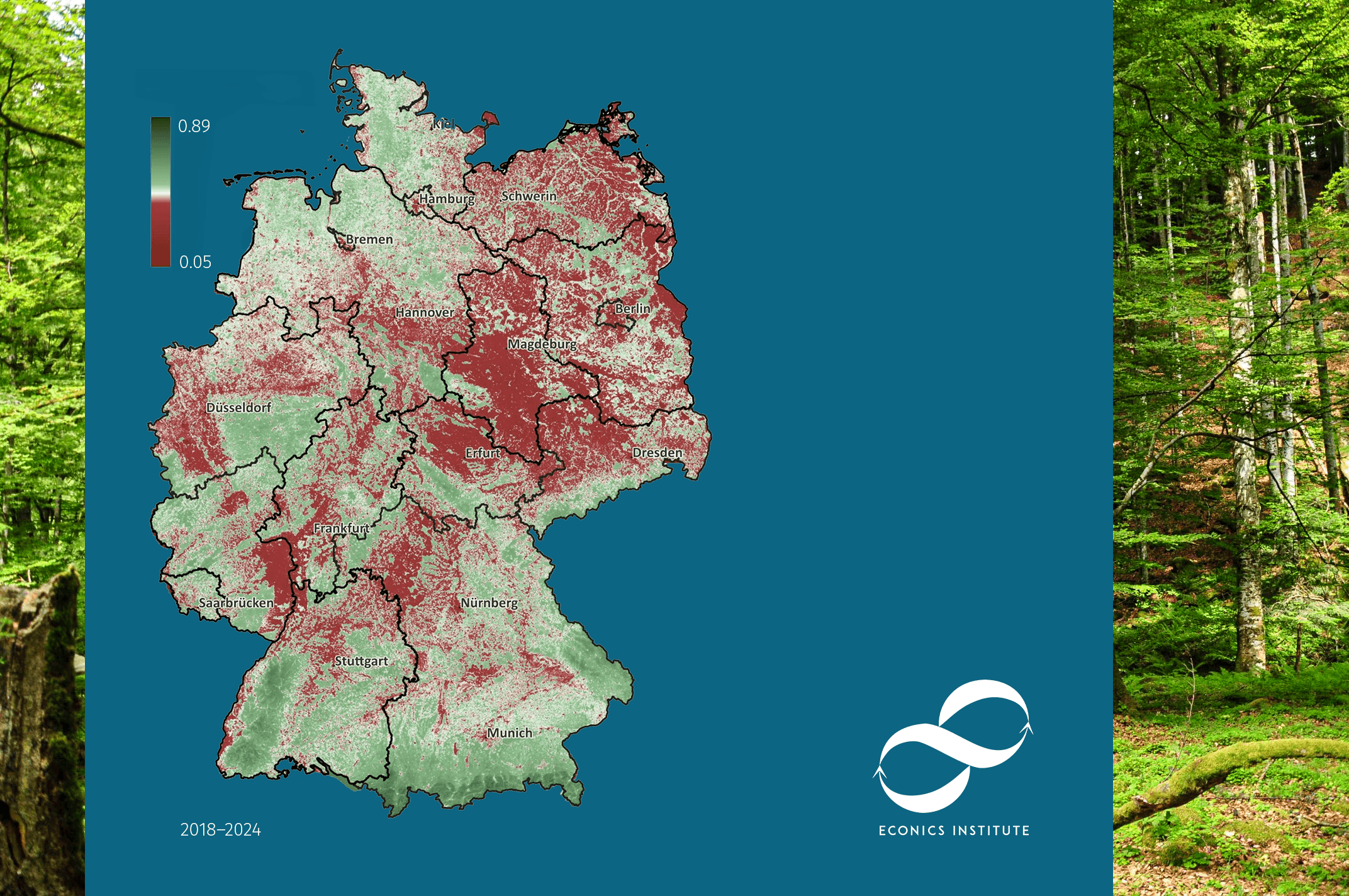
It is not only Germany’s major cities that are heat hotspots; there are also extensive heat landscapes. Land use is responsible for almost a fifth of the temperature differences, and where it is greener and cooler, there is even more precipitation. The Green-Wet-Cool Index (GMCI) shows the future potential and performance of Germany’s ecosystems.
We humans, today and in the future, need the forest for a good life. The social ecological approach does not rule out the management of forests; on the contrary, it makes it indispensable–treating all ecosystem services as potentially scarcening resources. In doing so, the triad applies that forest management should be ecosystem-based, ethically reflected, and must contribute to the short- and long-term well-being of people.
The Schöneberg Wild Forest is a forest area covering around 400 hectares in northeastern Brandenburg (Uckermark district). Forests planted decades ago have been dying for several years as a result of extremely hot and dry summers. But the forest is already growing again. With the support of the Umweltstiftung Michael Otto, we are investigating spontaneous regeneration in order to gain insights for sustainable forest management in times of climate crisis.
On behalf of the German Federal Ministry for the Environment and in collaboration with the transdisciplinary company agrathaer, we are evaluating the monitoring data for the UNESCO World Natural Heritage beech forests in Germany. Grumsin, Hainich, Jasmund, Kellerwald, and Serrahn are part of a European World Heritage Site. What can we learn from them?

As part of an event organized by the State Working Group on Trees at BUND Saxony-Anhalt, Prof. Dr. Pierre Ibisch presented a new approach to socio-ecological wetland management.

Old deciduous forests have made it through the last few extreme summers relatively healthy and cool. At the same time, warming is rapidly increasing. What strategies are there to preserve our landscape as a vital resource?