

Following welcome remarks from the City of Bernau and the neighborhood forum, Kommunales Nachbarschaftsforum Berlin–Brandenburg e.V. (KNF), two keynote inputs framed the discussion. Prof. Dr. Pierre Ibisch introduced the core concept and potential benefits of UNESCO Biosphere Reserves, drawing on examples such as the Wienerwald biosphere park in Vienna and the “Living Coast” biosphere region near Brighton, England. Prof. Dr. Jörg Knieling built on this by outlining the participation and governance framework underlying the ongoing feasibility study.
Participants then worked in two facilitated rounds at six tables, guided by structured questions. The first round focused on identifying and spatially mapping the region’s strengths and challenges. The second round shifted to visions, expectations for potential services, territorial options, and relevant partners. Methods included moderation cards, dot voting, and large-format maps covering landscape types and protected areas. In total, nearly 400 contributions were documented.
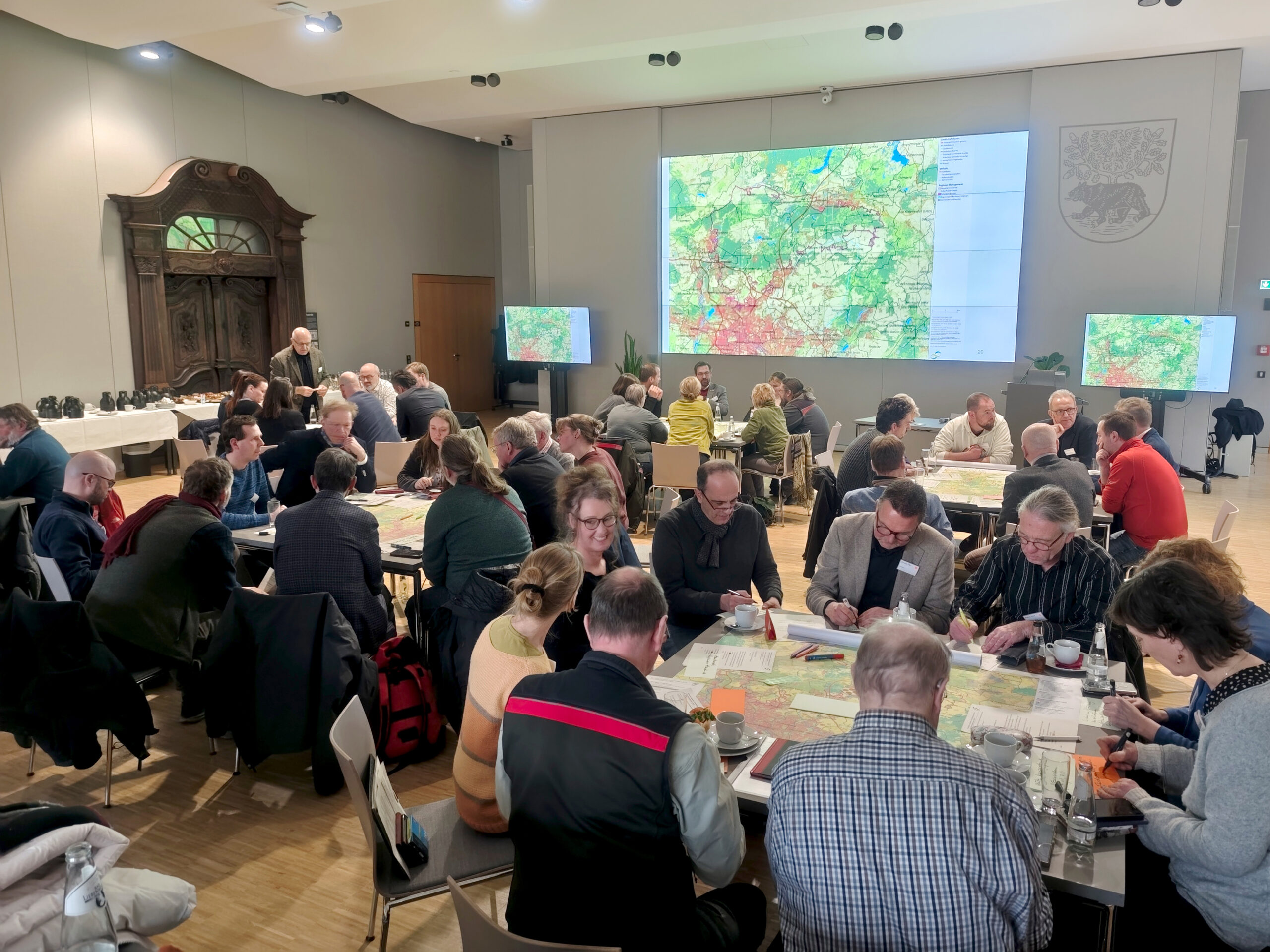
Among the region’s strengths, participants most frequently highlighted its natural landscapes and existing protected areas — notably the cross-border Barnim Nature Park — alongside strong recreational and tourism offerings and well-developed educational and knowledge infrastructure. Regional economic value chains, particularly in agriculture, and energy-related topics also featured prominently.
On the challenges side, governance complexity across the Berlin/Brandenburg state border emerged as a dominant concern, alongside questions around funding and implementation as well as settlement expansion and increasing pressure on land use. Participants also repeatedly raised issues of water management and climate change, as well as land use conflicts stemming from increasing pressure on natural areas through recreational activities.
Looking ahead, participants’ visions converged around quality-oriented, land-efficient development, stronger green spaces, and improved ecological connectivity across the region. There was a strong call for more binding urban-rural cooperation, a coherent regional narrative, and tangible added value — including greater visibility, better access to funding, and more effective cross-boundary coordination.