
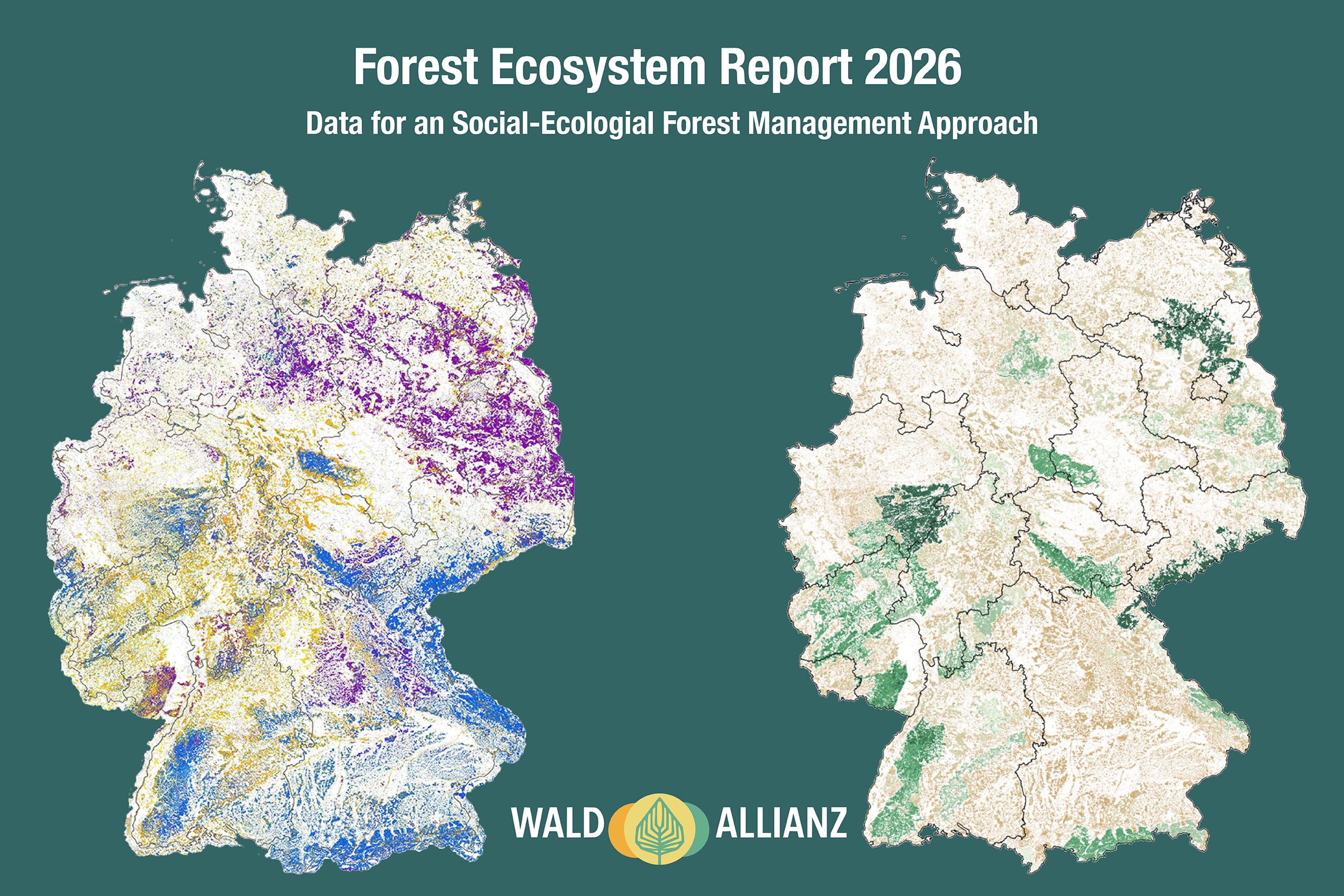
A nationwide network of forest owners, managers, researchers and activists, the Forest Alliance’s (Wald-Allianz) members jointly advocate for social-ecological forest management that considers ecological functioning, natural adaptability and social responsibility as interconnected. The Alliance’s new Forest Ecosystem Report breaks new ground: the report covers the entire country at a resolution of 10 × 10 metres and, for the first time, relates the condition of forests to who owns them.
To produce the report, researchers at the think tanks Natural Forest Academy (Naturwald Akademie) and ECONICS INSTITUTE teamed up with the remote sensing company Remote Sensing Solutions to analyse satellite data from 2017 to 2026. Greenpeace Investigativ and the freedom-of-information platform FragDenStaat contributed data on forest ownership.
One of the report’s key findings: broadleaf forests weakened by years of climate stress recovered in 2025. The Forest Alliance advocates working with natural processes in transforming Germany’s forests and giving broadleaf forests room to develop on their own.
The report goes far beyond the government’s forest condition surveys: it examines a range of ecological characteristics of the forests and, for the first time, provides a nationwide analysis of how they have developed over the past ten years. In doing so, it contradicts widely held assumptions in forestry, where the native beech is often considered to have little future, while the North American Douglas fir is frequently seen as better equipped for changing conditions. Yet 85 percent of beech forests are stable, the report shows, and only three percent unstable. Douglas fir, by contrast, has shown poor condition values throughout the ten years studied, with no recovery.
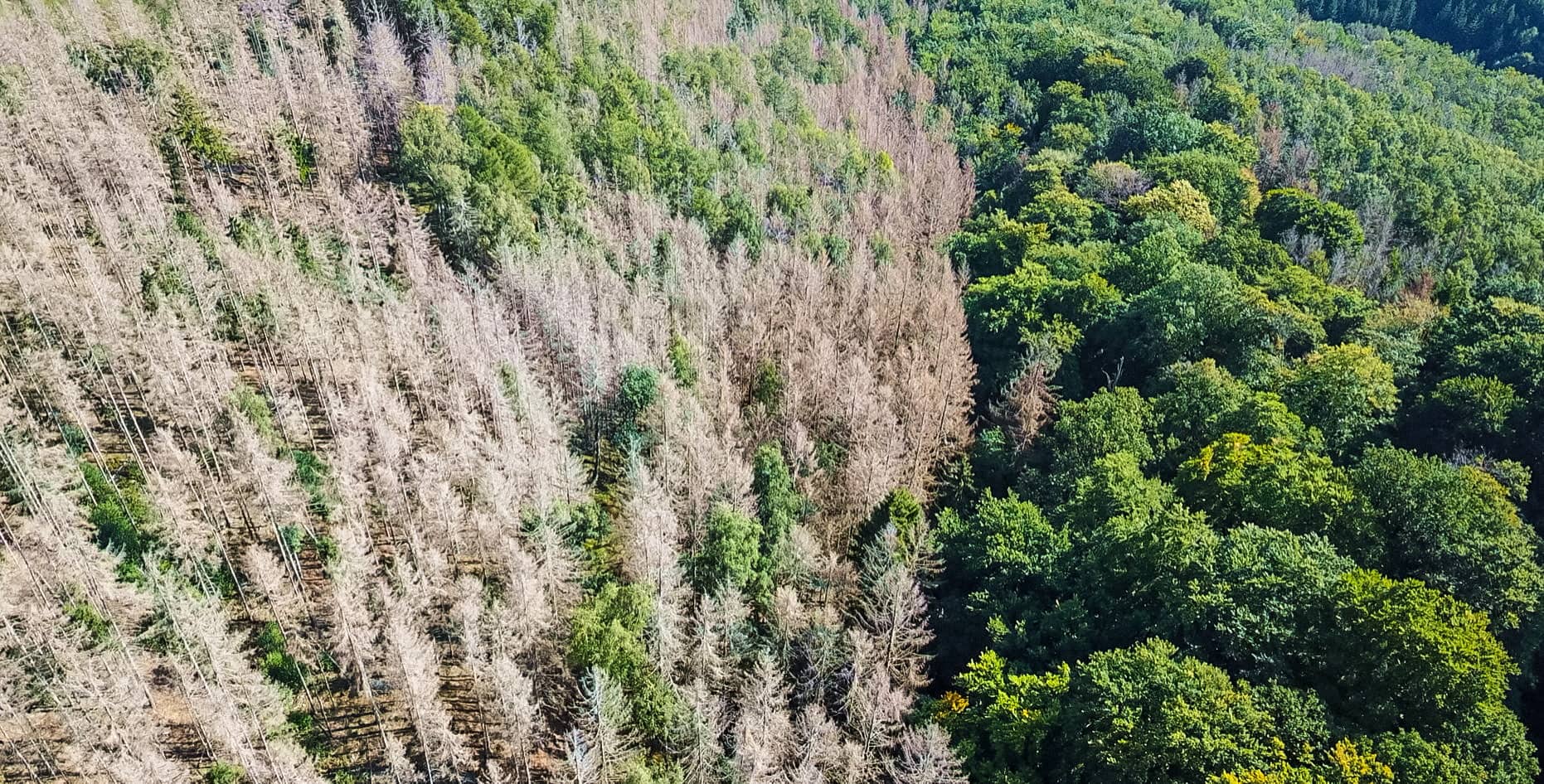
“It is good that forestry is increasingly relying on diverse forests. But forests cannot simply be converted. They are living ecosystems. Their adaptability and natural processes should therefore be harnessed in transforming them,” stresses Dr Torsten Welle, Managing Director of the Naturwald Akademie.
The Forest Alliance, calls for forests to be managed with care and, above all, for old broadleaf stands to be preserved. Tall, broadleaf-dominated and less fragmented forests are particularly effective at cooling, the analysis shows. On hot days, beech forests, for example, were 4.7 degrees cooler than their surroundings. “The cooling capacity shows why the ecological condition of forests matters so much. Private forest owners need political support so that forests are allowed to grow taller and older,” explains Prof. Dr Pierre Ibisch, Executive Board member of the ECONICS INSTITUTE.
The ownership research makes comparison possible: only eleven percent of privately owned forest is in good ecological condition, compared with 25 percent of state-owned forest. But there, too, there is considerable room for improvement. “How forests should be managed in the future is something society as a whole must discuss. In the Forest Alliance, science, civil society and forestry practitioners are working together for social-ecological forest management,” says Clara Buer, project lead of the Forest Alliance, and Greenpeace spokesperson.
The Forest Alliance (Wald-Allianz) comprises Greenpeace e.V., Naturwald Akademie, ECONICS INSTITUTE, Bergwaldprojekt, Wohllebens Waldakademie, Ecosia and Umweltstiftung Greenpeace, as well as ten forest partners from seven German federal states.
Find out more on our project page. The full report (in German), with all maps and analyses, is available for download here.