
Forest ecosystems are far more than different tree species planted and grown by foresters. Forests are self-regulating systems that manage their own energy, water and nutrient budgets. Their vitality and potential for development are strongly influenced by land use, the surrounding landscape and climate change. The social-ecological approach underlying the Forest Ecosystem Report by the Forest Alliance (Wald-Allianz) allows a comprehensive view of forest development and increases transparency for all citizens whose well-being depends on forests.
Forests provide a wide range of ecosystem services that are indispensable for human well-being, especially in the climate crisis. Many of these services have so far not been adequately taken into account or valued. In view of accelerating human-made climate change and the resulting shift in society’s priorities for how ecosystems are treated, forest management requires an adaptive approach to an even greater extent than before. This means that damage to forests must also be examined for mistakes in how ecosystems have been managed, and that the effectiveness of strategies must be reviewed regularly. This calls for appropriate, transparent analyses with high temporal and spatial resolution that allow us to learn and to change course where necessary.
The Forest Ecosystem Report is the first nationwide report on the current condition and development of Germany’s forests based on high-resolution satellite data (10 × 10 metres). Not only its approach, data basis, spatial resolution and accuracy are innovative: it also presents complex analyses and statistical evaluations that have not existed before. Unlike the official forest condition reports, which assess the tree crowns of selected species on sample plots, the Forest Ecosystem Report analyses forest fragmentation, vitality, forest stability, cooling effects and other important indicators of the condition of forest ecosystems across the whole of Germany. The data analysed range from 2017 into the current 2026 growing season. It was produced by the Naturwald Akademie, the ECONICS INSTITUTE and the technology provider Remote Sensing Solutions.
Given the great complexity of the factors affecting forest ecosystems, this study cannot, of course, examine every relevant or desirable aspect needed to do justice to the complexity of forest ecosystems with their many life forms, organisms, interactions and functions. The report should therefore be understood as a starting point for a process that will require further resources and, above all, open-mindedness.
For the first time, the report also draws on a nationwide geospatial dataset on forest ownership. Greenpeace Investigativ and the freedom-of-information platform FragDenStaat requested these data from all federal states and the federal government under the Environmental Information Act. The dataset makes it possible to take ownership into account in nationwide spatial analyses. However, comprehensive ownership data are not available for all federal states.
Loss of large forest areas, fragmentation and negative edge effects
The total area of forest with more or less tall trees in Germany declined by 13.32 percent: from 12.46 million hectares in 2017 to 10.8 million hectares in 2025. Although these areas are still legally classified as forest, satellite imagery no longer identifies them as tall forest, and they have lost their ecosystem-typical functions. On some of these areas, shrubs and more or less young trees are initiating a recovery of the ecosystems.
A key and still underestimated problem of Germany’s forests is their exceptionally high and increasing degree of fragmentation. Germany’s forest is a patchwork: since 2017, the number of fragments has risen by 11.61 percent. It consists of 4.3 million mostly small ‘islands’, each surrounded by a strip of non-forest at least 10 metres wide and only 2.71 hectares in size on average. Since 2017, this represents a 23.61 percent decrease in average size. The median size fell by as much as 55.56 percent, indicating a shift towards smaller forest areas. The largest forest area shrank by 42.63 percent – a considerable loss of large contiguous forests. The situation of broadleaf forests is particularly critical. Their area decreased by 10.62 percent, from 5.54 to 4.95 million hectares. On average, their unfragmented patches are just 0.6 hectares in size. Even the largest contiguous broadleaf forest areas are smaller than many conifer plantations. In 2025, Germany’s largest contiguous forest area covered almost 200,000 hectares (Ore Mountains, Saxony), whereas the largest contiguous area of pure broadleaf forest was only around 17,800 hectares (Hainich, Thuringia).
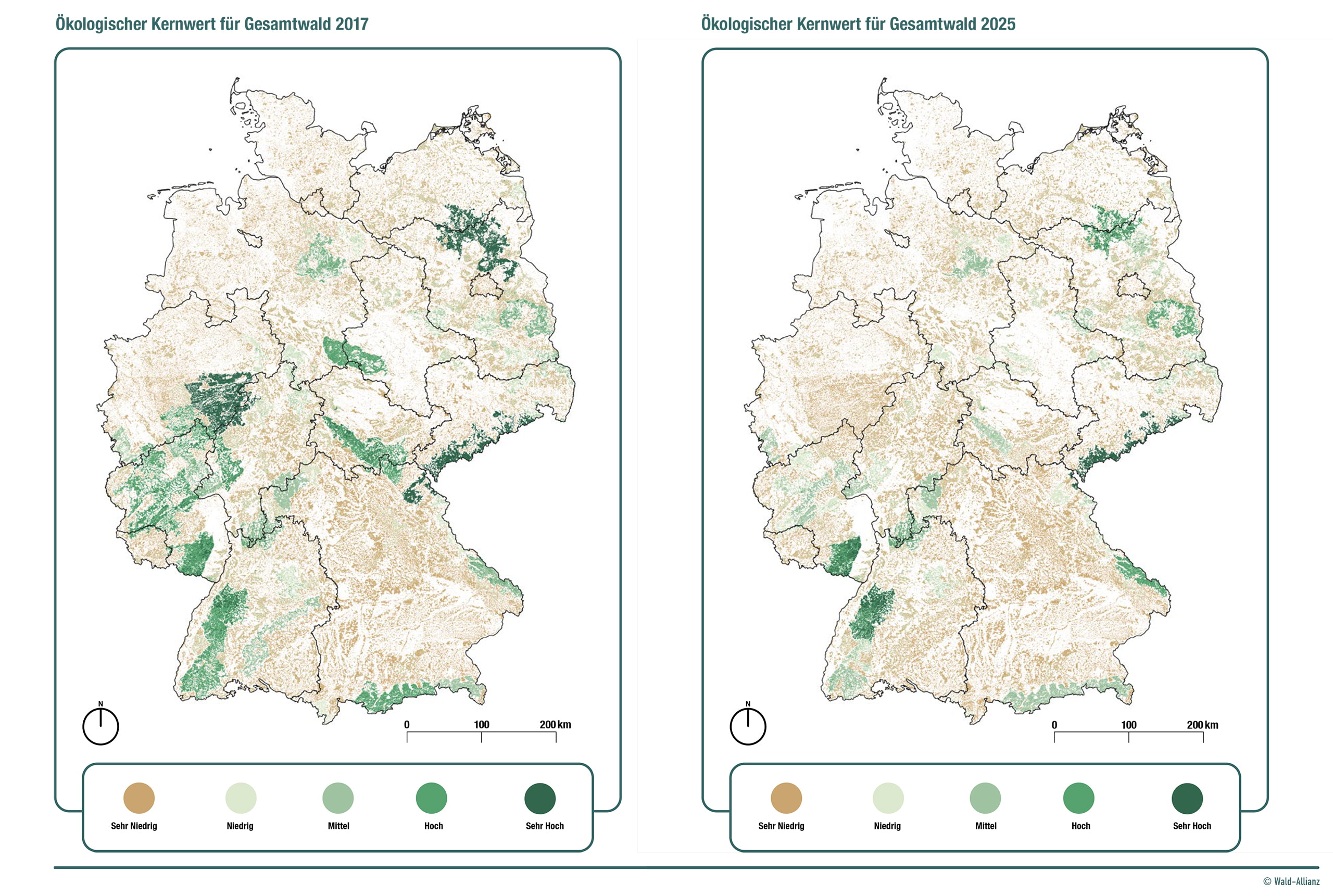
Small, fragmented forests heat up considerably more on hot days. This relationship can be shown using the “Ecological Coreness”, which reflects the spatial integrity of forests. As an indicator of connectivity, it shows how well individual forest areas are embedded in the wider forest landscape. In 2026, forest areas with an Ecological Coreness value of 0.05 had a surface temperature roughly 0.6 to 0.63 °C lower than those with a value of 0.02. In most federal states, fragmentation is very pronounced. Notably, even in state-owned forests, hardly any larger areas with higher Ecological Core Values remain in most of the larger federal states. The ecologically more valuable forest areas are found almost exclusively in large protected areas. At the same time, forests with high and very high Ecological Coreness suffered the greatest losses: their area declined by around 1.17 million hectares.
Declining vitality and growing damaged areas in conifer plantations
Over the past ten years, at least 600,000 hectares of damaged forest have emerged – around 5 percent of Germany’s forest area. 80 percent of this is in conifer plantations and 20 percent in broadleaf forests. The area of newly recorded damage grew each year from 2018 to a peak of around 107,000 hectares per year in 2022. Damage then declined until 2024, before rising again between 2025 and 2026. The damage mainly affects monocultures of tree species not suited to the site and with little structural diversity. This poses an ecological and economic risk, because such stands can fail simultaneously and across large areas.
The report measures forest vitality using the NDVI (Normalized Difference Vegetation Index) – an indicator of vegetation greenness calculated from satellite data. For each forest area, the highest value of each year, the seasonal NDVI maximum, is analysed. A rising value may indicate better foliage, but on damaged areas it may also reflect regrowing grasses, shrubs and young trees. Forest vitality in Germany mostly declined between 2017 and 2024. Since 2025 it has been rising, a trend that is continuing in 2026. One reason is likely to be that the spruce plantations hit hardest by the extreme weather of recent years have largely died off and are therefore no longer reflected in current vitality trends. The growth of shrubs and young trees on damaged areas may also contribute to a positive signal. The partly severe effects of heat and drought in the south and west of the country in 2026 are expected to show up only in next year’s data. The data so far already reveal clear differences in vitality trends between the dominant tree species.
Broadleaf forests comparatively stable, spruce and also pine plantations increasingly unstable
The new Forest Stability Index (ranging from 0 to 1) distinguishes five classes and shows, for every forest area, how much forest vitality (NDVI) fluctuated from year to year between 2017 and 2026. High values indicate consistent vitality, low values strongly fluctuating vitality, for example due to dieback, clearance or reforestation.
On two thirds of Germany’s forest area, vitality (measured as the annual seasonal NDVI maximum) changes comparatively little. Nationwide, 66.4 percent of the forest area falls into the ‘stable’ and ‘very stable’ classes, 12.6 percent into ‘unstable’ and ‘very unstable’, and a further 21 percent into the middle class. Of beech forests, 85.5 percent are classified as stable (stable and very stable classes), compared with 80.4 percent of oak forests and as much as 90.3 percent of alder forests. Only 3 percent of beech forest area is unstable. There is currently little evidence that beech will reach its ecological limits across large areas of Germany in the future, although increasing susceptibility to drought stress can be expected regionally and depending on site conditions. Existing spruce and pine plantations have the highest proportion of unstable areas. As they still make up a large share of Germany’s forest area, they will continue to pose a considerable ecological and economic risk. Their gradual development into forests of ecosystem-typical tree species should therefore be pursued swiftly and consistently on a large scale. By contrast, deliberately introducing tree species imported from other continents because of their presumed ‘climate resilience’ is not considered an effective strategy. The introduction of further conifer species is viewed particularly critically.
Forest ecosystem services and risks to people
Looking at the most important tree species (85 percent of forest area), it becomes clear that they differ in how much they cool their surroundings. This is due to species-specific traits such as transpiration rates, but also to differences in forest structure (e.g. the complexity of the canopy, its ‘roughness’). Compared with the surrounding non-forest land, beech forests are 4.7 °C cooler and oak forests 4.68 °C. For spruce the figure is 4.03 °C, and for pine plantations just 3.55 °C.
Functioning forests not only provide ecosystem services but also reduce various risks to the population. In this context, the report presents the first map of current forest fire risk in Germany. It is based on a risk index that combines several factors influencing fire risk: the flammability of the dominant tree species, temperatures and precipitation in the previous year, strong fragmentation with many edge effects (Ecological Core Value) and the decline in vitality in the previous year (2026). Brandenburg in particular is a high-risk state (75 percent of its forest area at high or very high risk). However, every state has significant areas at high or very high risk.
For regulating forest ecosystem services, such as cooling the landscape on hot days, stable, tall (and thus usually older), large and well-connected forest ecosystems are particularly important. These are also the forests that contribute most to climate change mitigation by capturing and storing greenhouse gases. Broadleaf forests in particular are highly relevant for regulating services. The same forest areas also have a lower potential risk of forest fires. They matter for human health and stabilise economically relevant parameters – for example by supplying water to the landscape and to rivers. These services deserve greater recognition in society and corresponding funding programmes. The health-related ecosystem services associated with them in particular need to be made better known in Germany.
The downside is just as invisible: the value created in the forestry and timber sector is offset by hidden costs that have so far not been systematically recorded. Unsuitable silviculture and timber harvesting damage soils, biodiversity and the resilience of forests. The costs of dealing with disturbances and forest fires, for example, are generally borne not by forestry businesses but by society – the special aid package in response to the forest crisis alone mobilised around 800 million euros for the years 2020 to 2023.
All forest-related ecosystem services and risks to people should therefore be regularly quantified, mapped and assessed. The forest fire risk map presented here shows how such an approach can support risk management at national, regional and local level.
Recommendations for social-ecological forest management
The findings of the Forest Ecosystem Report show that the situation of Germany’s forests is more critical than the sample-based forest condition reports of the federal and state governments suggest. Based on a broad and robust data set, they support the approaches of ecosystem-based and social-ecological forest management. Among the resulting recommendations:
- Strengthen ecosystem-based and social-ecological forest management: Forest management must be guided first and foremost by the ecological functioning of forests and the many services they provide to society. State-owned forests should lead by example, and advice to private forest owners must be aligned accordingly.
- Prevent further fragmentation: Avoiding any further fragmentation of tall forests deserves the highest priority in planning and environmental policy. Small and very small forest fragments should be consolidated and linked by corridors. Buffer zones should be established along forest edges, especially around valuable broadleaf forests.
- Allow natural regeneration: During and after disturbance events, clear-cuts and large-scale removal of biomass should be avoided to allow tall forest to recover more quickly. The aim should be structurally rich forests of ecosystem-typical tree species.
- Protect and connect valuable forests: Forests of high structural and landscape-ecological value must be effectively protected. This includes placing more forest areas under strict protection, promoting forest wilderness areas and better connecting protected forest areas.
The complete report (in German), with all maps, evaluations and analyses, can be downloaded here.