
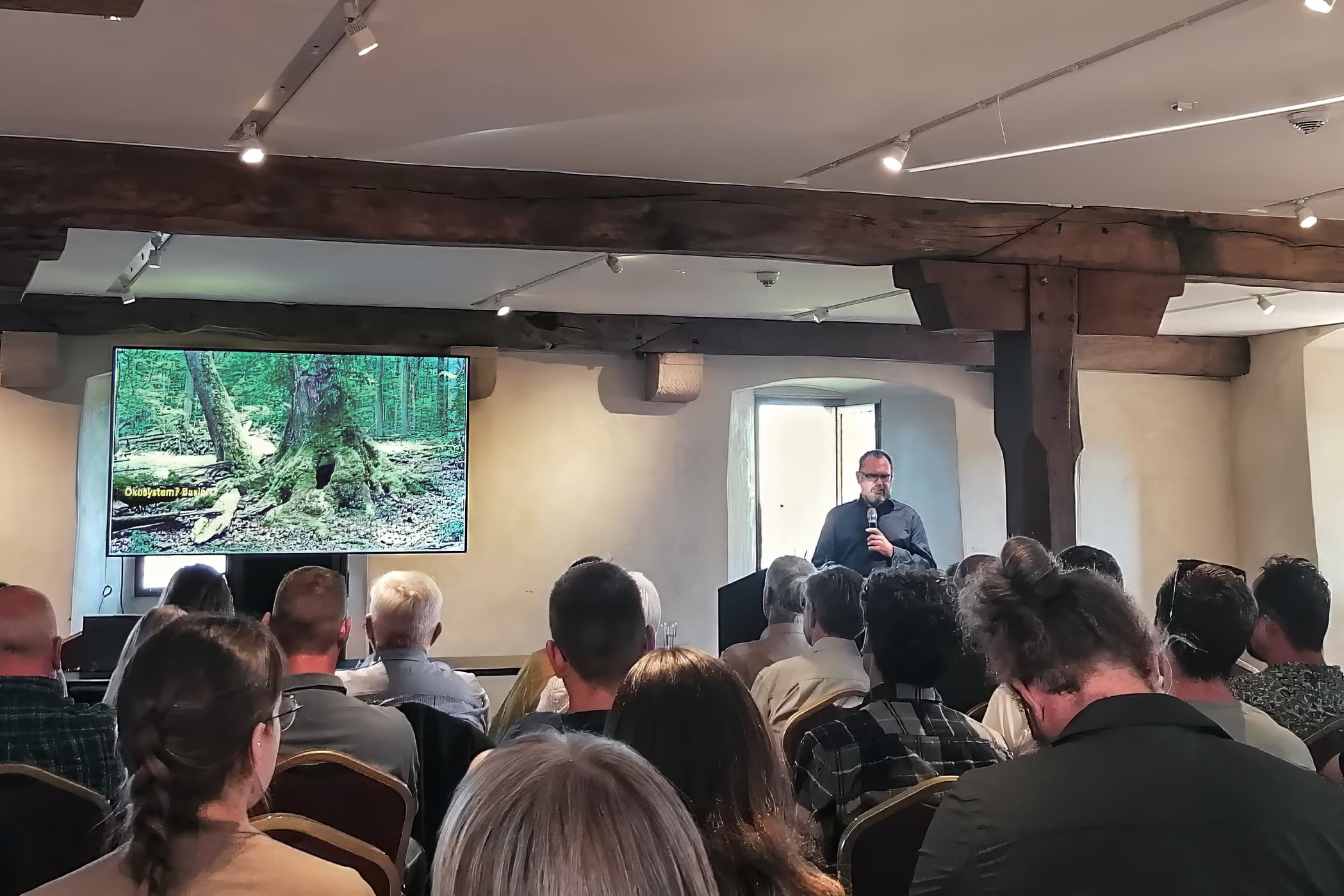
On the occasion of the annual conference of the Association des Forestiers Luxembourgeois (Asbl) Prof. Pierre Ibisch was invited as a guest speaker at Château de Bourscheid to speak on the topic “It’s All a Question of Energy: Ecosystem-Based Forest Management and Pronaturation.” Forests are complex systems: their ecological processes and functions do not work simply because they consist of individual parts, but because those parts interact with one another. Their capacity for self-organisation, as well as their chaotic properties, result from the diversity of chance-influenced interactions and countless feedback loops. In this process, forests transform energy, perform work and manage scarce resources.
These insights from ecosystem ecology have tangible implications for the aims and practices of forest management in the climate crisis. In view of our irreducible uncertainty about the future and the necessary end of static management, it is crucial to consistently support forests’ capacity to function. The way back to the past is blocked: the aim is not conservation or restoration in the narrow sense. Nor is there such a thing as “potential natural vegetation”. Restoration measures often seek to return ecosystems to an assumed original or potentially natural state, or to restore particular species and habitats. Yet such targets rest on a static understanding of nature that places humans in opposition to nature, rather than recognising them as part of a social-ecological system. They also disregard the unpredictable dynamics of anthropogenic climate change—historical reference states simply cannot be restored.
We should therefore pursue an open-ended yet goal-oriented form of pronaturation, in which natural systems are allowed to achieve their thermodynamic potential and thus maximise their physical working capacity under the given conditions, based in particular on the biomass available in the system, as well as the information and network of the ecosystem components.