
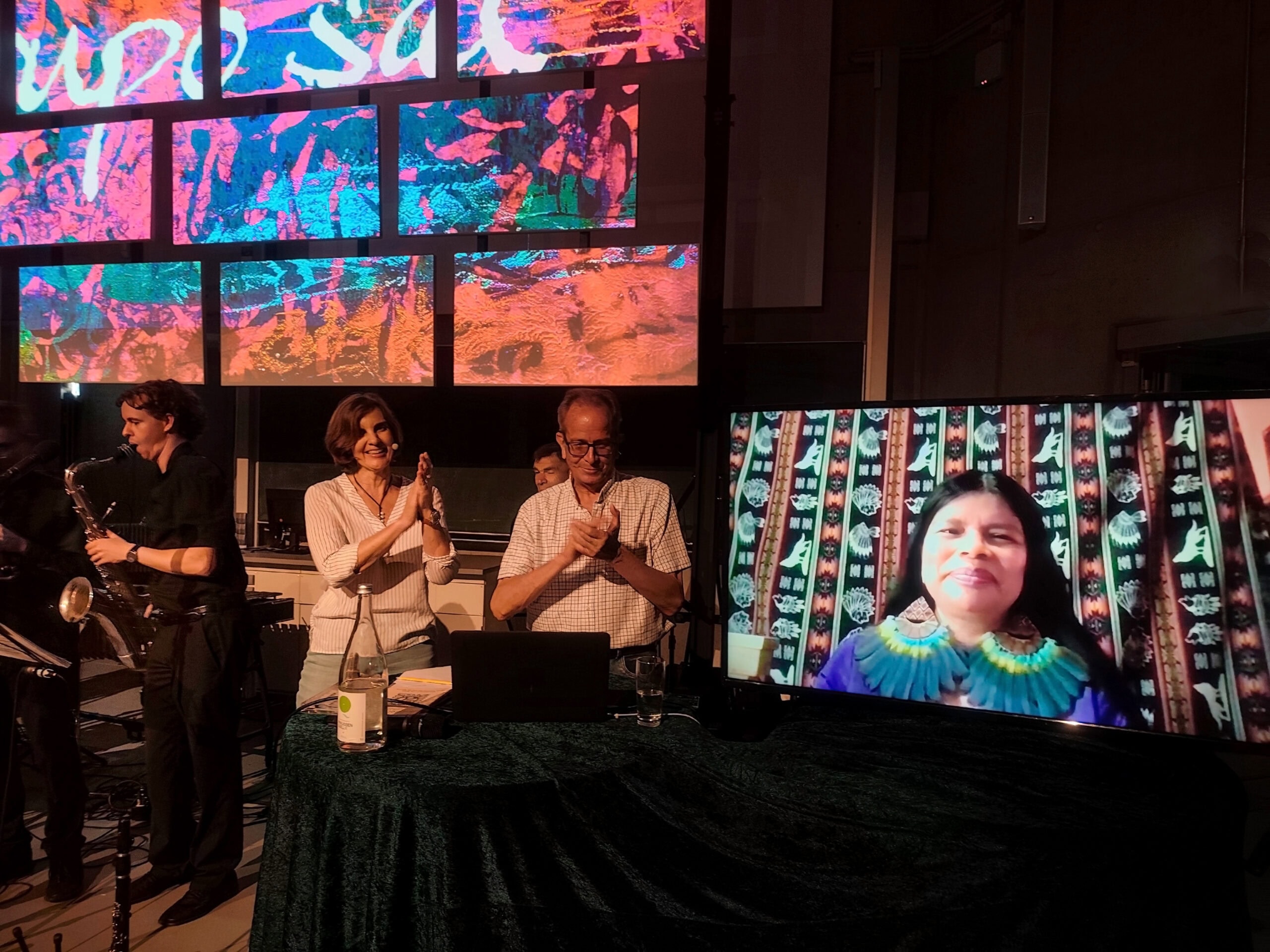
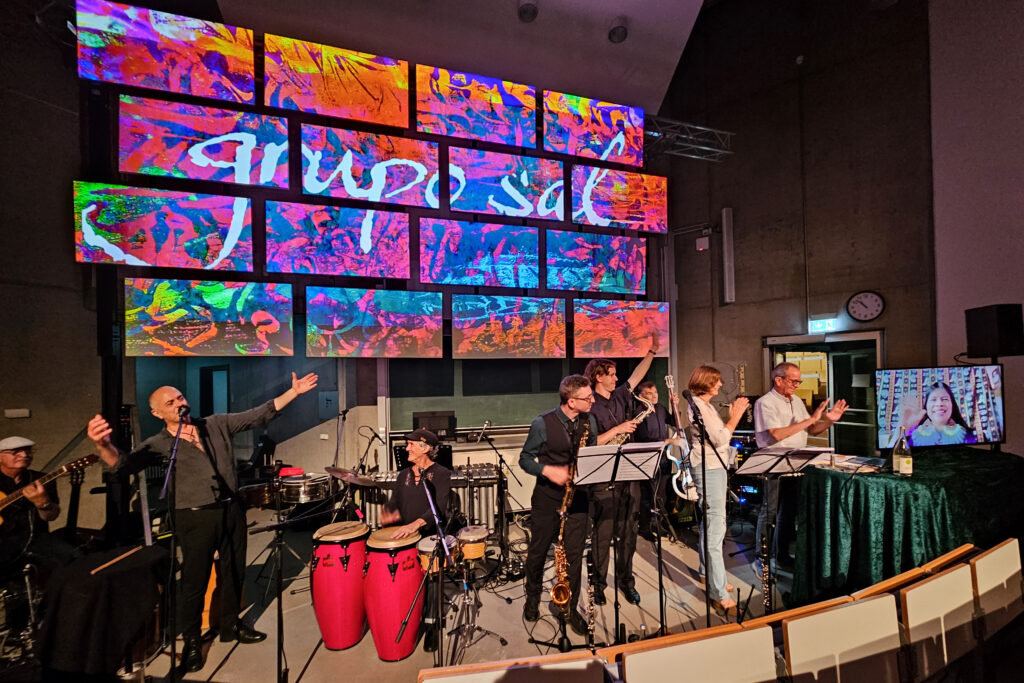
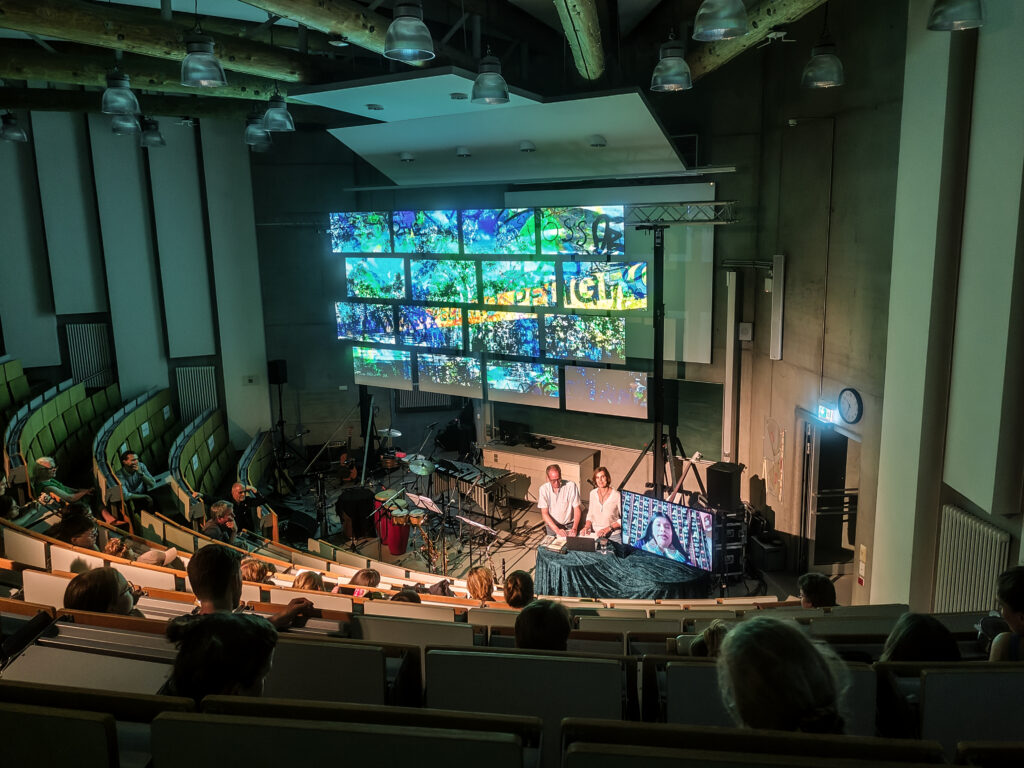
On June 29, 2026, the world came to Eberswalde – or rather, an entire pluriverse did. Under this title, Ecuadorian economist and politician Alberto Acosta, journalist Sandra Weiss, and the music ensemble GRUPO SAL created an evening devoted to the central questions shaping our shared future.
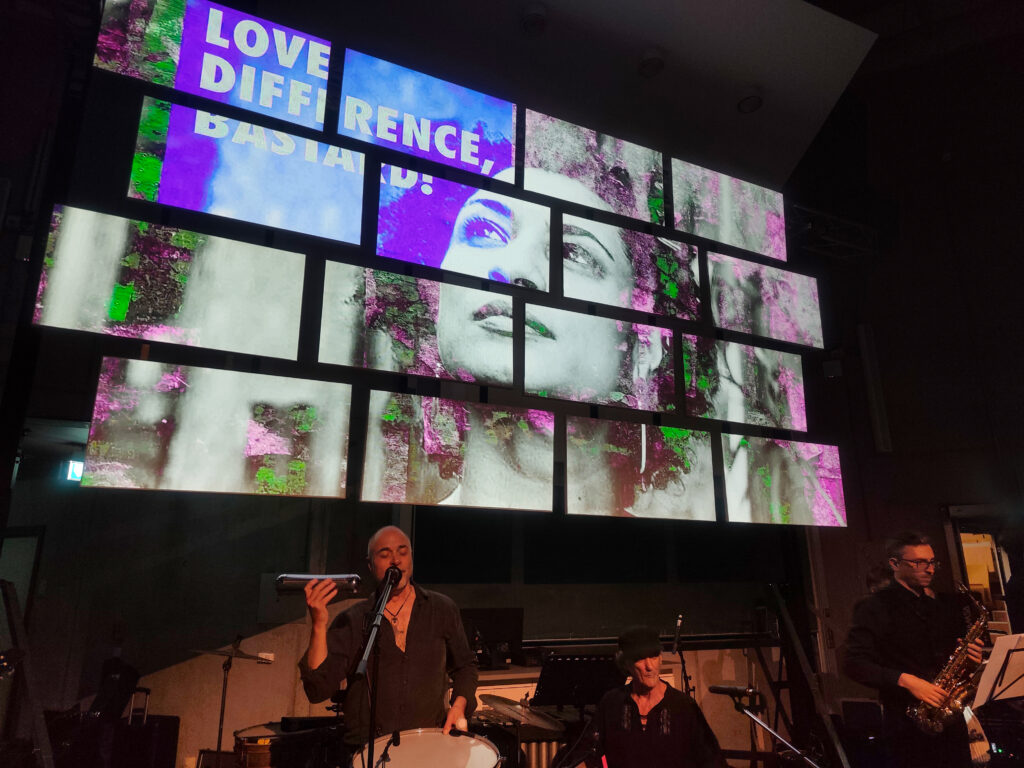
The evening explored the rights of nature, Indigenous perspectives, the role of civil society, and the question of how stronger connections can be forged between the Global South and the Global North. Political analysis, development perspectives, music and large-scale visual projections by artist Johannes Keitel came together in a powerful programme guided by a central question: what must change now to build a more just world?
Alberto Acosta is widely regarded as one of the leading international voices for socio-ecological transformation. As president of Ecuador’s Constituent Assembly, he played a key role in bringing the concept of Buen Vivir to wider international attention and in embedding it in Ecuador’s constitution in 2008. He has also served as Ecuador’s Minister of Energy and Mining and, in 2014, ran for president as the candidate of the Pachakutik party. Acosta is also known internationally for his role in the Yasuní-ITT Initiative, which proposed leaving part of the oil reserves in Ecuador’s Yasuní Biosphere Reserve untapped in return for international financial support. In his writings, Acosta has long explored alternatives to development models centred on economic growth and resource extraction — including his 2015 book The Buen Vivir: An Opportunity to Imagine Other Worlds.
Patricia Gualinga of the Pueblo Kichwa de Sarayaku joined as a special guest. An internationally acclaimed Indigenous activist, she is a member of the United Nations Permanent Forum on Indigenous Issues (UNPFII) and a leading voice in a steadily growing movement of women committed to protecting the Amazon. Her work has been recognised with numerous honours, including the Franco-German Prize for Human Rights and the Rule of Law, the Olof Palme Prize, and the Hans Carl von Carlowitz Sustainability Award.
The Kichwa community of Sarayaku lives deep in the Ecuadorian Amazon and has fought for decades to defend its ancestral land. In 1996, the Ecuadorian state granted large parts of their territory to the oil company CGC, without informing or consulting the community beforehand. What followed was a landmark legal battle: in 2012, the Inter-American Court of Human Rights ruled against Ecuador — a verdict still regarded as a milestone for indigenous rights across Latin America. This resistance also gave rise to a vision for the future of the Amazon: Kawsak Sacha, “the Living Forest.”
The General Assembly of the Original Kichwa People of Sarayaku declared their ancestral territory to be Kawsak Sacha — the Living Forest, a living and conscious being, subject of rights, constituted by all the beings of the forest, from the most infinitesimal to the greatest and supreme beings — including beings from the animal, plant, mineral, spiritual and cosmic worlds, in intercommunication with human beings. Kawsak Sacha is far more than a conservation concept: it is a proposal for life, offered to the world from the heart of the Amazon.
The event was organized by the Socialecological Forest Management study programme at the Eberswalde University for Sustainable Development, in cooperation with ECONICS INSTITUTE e. V., and supported by CHORONA Immobilien GmbH as well as Globus Naturkost — many thanks to everyone who made this evening possible!