
Within the Lower Oder Valley National Park lies the former Schöneberg Forest. It was planted over 40 years ago as a managed forest and incorporated into the national park in 1995. After the extreme, hot and dry summers of 2018 and 2019, large parts of the planted stands died off. Across this roughly 400-hectare area, heat and drought stress was further amplified by severe edge effects from the surrounding open landscape. Instead of managing the area as a forest, we are leaving it to its own devices. The “Schöneberg Forest” has become the “Schöneberg Wild Forest”, where the ecosystem itself is in charge.
What first looks like collapse is actually the start of a forest’s return. Dead trees still cast shade as standing deadwood, and the fallen trunks, lying criss-crossed like a game of pick-up sticks, form a natural shield against browsing. Roe deer, red deer and wild boar live here, and we have caught them on camera traps, along with wolves. Even so, the forest is regenerating. Because there is no hunting, we can study how ecosystems recover without any hunting intervention at all.
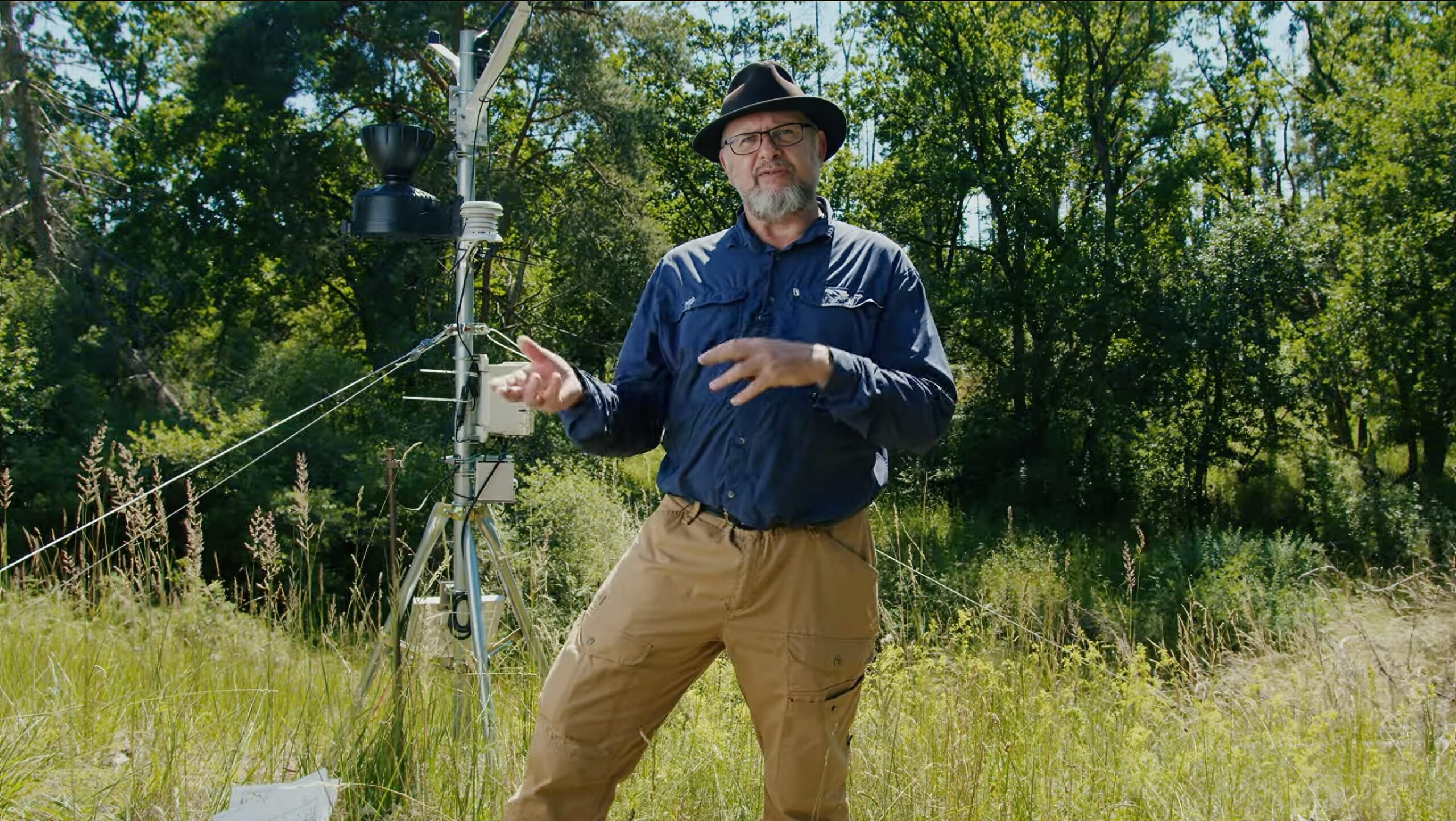
The ECONICS INSTITUTE is providing scientific support for this process. Our own weather station supplies on-site data on rainfall and temperature. We have set up 30 study plots, where we survey the vegetation and use data loggers to record temperature, air humidity and soil moisture every 15 minutes. We also analyse satellite imagery to identify which stands have lost or gained vitality since 2017. Our goal is to understand how a forest’s self-regulation restarts after such a disturbance, and what cost-effective, ecologically sound lessons can be drawn for managing forests under today’s climate conditions.
For us, the Schöneberg Wild Forest is an open-air laboratory where we want to make forest change tangible. During the first project phase, we already shared observations and findings on guided excursions and put up an information board. Together with the national park, we want to expand and establish this science-based nature experience as an interpretive trail. We hope to show the public, national park visitors and foresters alike that forest change, and even forest recovery, is possible under the especially extreme climate conditions of the 21st century in north-eastern Brandenburg.
Scientific monitoring of the Schöneberg Wild Forest, communication about its dynamic forest development, and the design of an interpretive trail all take time and resources, which we are keen to invest. We therefore ask for your support, and we thank you warmly, also on behalf of the Lower Oder Valley National Park.